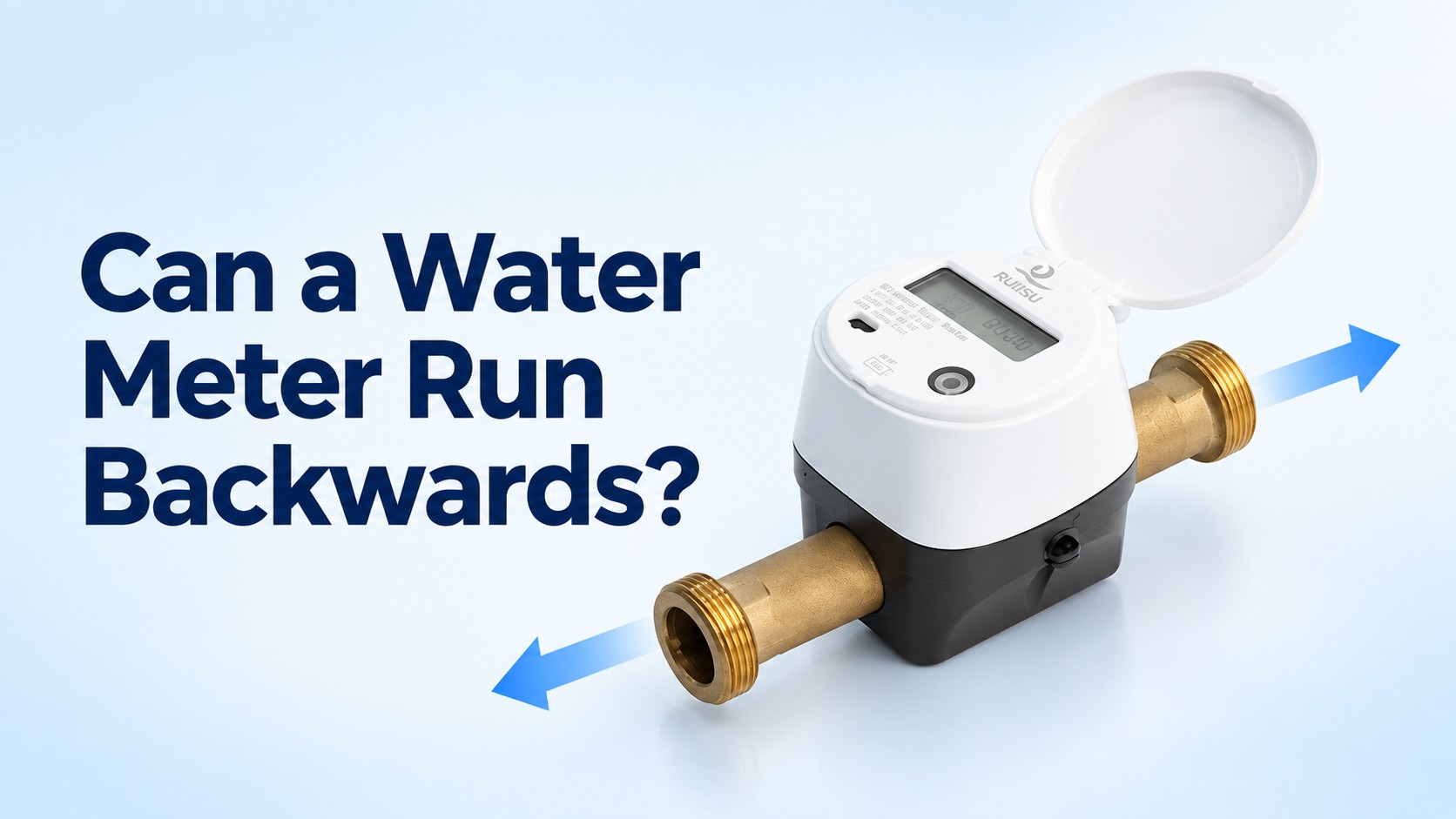
Yes, a water meter can experience reverse flow, but not every model measures it accurately. Depending on its design, the meter may subtract reverse volume, record it separately, block it, or simply withstand a brief reversal.
Which Water Meters Can Measure Reverse Flow?
A meter can only measure reverse flow reliably when its design, register, and approval cover both directions. Water moving backward through a meter does not automatically mean the displayed reverse volume is accurate.
Some mechanical meters rotate backward when the flow reverses. Others may stall, count incorrectly, or suffer a change in forward-flow accuracy after a severe event.
Electronic ultrasonic and electromagnetic meters can detect flow direction directly. However, their firmware determines whether reverse volume is deducted, stored separately, ignored, or used to trigger an alarm.
The OIML R 49 water meter requirements distinguish meters designed to measure reverse flow from those only required to prevent or withstand it. Always confirm the model-specific documentation.
Three Ways Water Meters Handle Reverse Flow
Reverse-flow behavior affects billing, leak analysis, and network data. The three most useful handling methods are net subtraction, separate recording, and physical prevention.
1. Subtract Reverse Volume
The meter deducts reverse volume from the forward total. If 100 cubic meters move forward and 2 cubic meters return, the net indication becomes 98 cubic meters.
This method represents net transfer, but it can hide how often or how severely reverse flow occurred unless the meter also stores event data.
2. Record Reverse Volume Separately
The meter maintains separate forward and reverse totals. Utility software can then display gross forward usage, returned volume, and calculated net consumption without losing diagnostic information.
This is useful when you need to investigate pressure changes, pumping cycles, cross-connections, or abnormal movement within a distribution network.
3. Prevent Reverse Flow
A check valve or suitable backflow-prevention arrangement stops water from passing backward. This protects the network, but it is different from measuring reverse volume.
A meter is not automatically a certified backflow-prevention device. The required protection depends on local rules, water quality risks, and the type of cross-connection.
| Handling method | What the register shows | Main advantage | What to verify |
| Subtract | Forward volume minus reverse volume | Simple net total | Reverse accuracy and event history |
| Record separately | Independent forward and reverse totals | Better diagnostics | Display, data fields, and AMR output |
| Prevent | No intended reverse passage | Network protection | Valve type and local compliance |
Mechanical vs. Smart Water Meter Reverse Flow
Mechanical and smart meters may react very differently to the same event. You should never assume that backward register movement proves accurate bidirectional measurement.
| Meter type | Possible reverse behavior | Data available |
| Conventional mechanical | May rotate backward, stop, or register with uncertain accuracy | Usually one accumulated reading |
| Mechanical with directional encoder | Can distinguish forward and reverse pulses when designed for it | Direction and event data depend on the register |
| Ultrasonic or electromagnetic | Can identify signed flow electronically | Forward total, reverse total, net flow, or alarms may be available |
For example, our DN15–DN25 ultrasonic water meter with valve continuously measures forward and reverse water volumes. Its product page also documents Class 2 reverse-measurement performance.
How Smart Water Meters Generate Reverse Flow Alarms
A smart water meter or meter interface unit first identifies negative flow. The device or AMI platform then compares that measurement with a configured threshold, duration, or event rule.
The alarm may be generated at the meter, in the communication module, or after data reaches the head-end platform. Available logic varies by manufacturer and system configuration.
- Direction: Did the measured flow become negative?
- Volume: Did reverse volume exceed the configured limit?
- Duration: Did the event continue long enough to require attention?
- Context: Did nearby meters, pumps, or pressure sensors show a related event?
The U.S. EPA guidance on AMI monitoring notes that thresholds can reduce invalid alerts. Small pressure movements, trapped air, or thermal expansion may briefly create negative readings without a sustained backflow incident.
Why Water Flows Backward Through a Meter
Pressure-Driven Network Backflow
Reverse flow occurs when downstream pressure becomes higher than supply pressure. Pump shutdowns, elevated tanks, booster systems, thermal expansion, and sudden pressure loss can all reverse the pressure difference.
This is more than a metering issue when private water can return toward a potable main. A qualified professional should assess the cross-connection and select appropriate protection.
A Water Meter Installed Backwards
A meter installed against its flow arrow sees normal consumption as reverse flow. The register may decrease, roll from zero toward its maximum value, record a reverse total, or issue an alarm.
“Any-position installation” does not mean backward installation is acceptable. U0/D0 describes straight-pipe requirements, while the arrow on the body identifies the intended flow direction.
Short Back-and-Forth Movement
Air pockets, water hammer, pressure cycling, or water-heater expansion may make the indicator move briefly in both directions. Repeated oscillation can distort totals if forward and reverse accuracy differ.
Use our water meter installation guide to check the flow arrow, alignment, valves, trapped air, and leaks before blaming the meter.
Reverse Flow Risks and Checks
The risk depends on the source, duration, and meter response. A short pressure pulse is different from continuous return flow from a pump or incorrectly connected supply.
- Incorrect billing when reverse volume is added, ignored, or deducted unexpectedly
- Misleading consumption, leakage, and non-revenue-water data
- Repeated alarms that staff may begin to ignore
- Possible meter damage when the model cannot withstand reverse flow
- Water quality risk when an unsafe cross-connection allows backflow
Before purchasing, ask how the exact model handles reverse flow, whether accuracy applies in both directions, which totals are transmitted, and how alarm thresholds are configured.
FAQs about Water Meter Reverse Flow
Does a water meter reading decrease during reverse flow?
It may. Some meters subtract reverse volume, while others keep a separate total or continue displaying only forward consumption. Check the register and communication specification.
Can you install a bidirectional water meter backwards?
Not unless the manufacturer explicitly permits it. Bidirectional measurement describes flow detection, not permission to ignore the marked inlet, outlet, or flow arrow.
Is a reverse flow alarm proof of dangerous backflow?
No. It is a signal for investigation. Pressure fluctuations, air, or thermal expansion can cause small negative-flow events, while persistent reverse volume may indicate a serious connection problem.
Will a check valve affect the water meter?
It can change system pressure behavior and create a closed system. Valve selection, thermal expansion control, installation position, and local requirements should be reviewed together.
Choose the Right Reverse-Flow Meter
We supply mechanical, AMR, ultrasonic, and electromagnetic water meter options for different measurement and communication requirements. Review our ultrasonic water meter range or contact us with your flow, approval, and reverse-data requirements for a suitable model recommendation.