
AUTOMATIC WATER METER READING SYSTEM (AMR / AMI)
Meters, networks and a data platform — connected end to end.
Read every meter without sending anyone to read it
DEAZESU AMR and AMI solutions collect water-meter data remotely and deliver it to a central management platform. Utilities, property managers and industrial users can reduce routine site visits, improve reading accuracy and gain a clearer view of consumption.
HOW THE SOLUTION WORKS
The system has four connected layers. The meter captures consumption, the network transmits the reading, the platform organises the data and the application turns it into useful operational information.
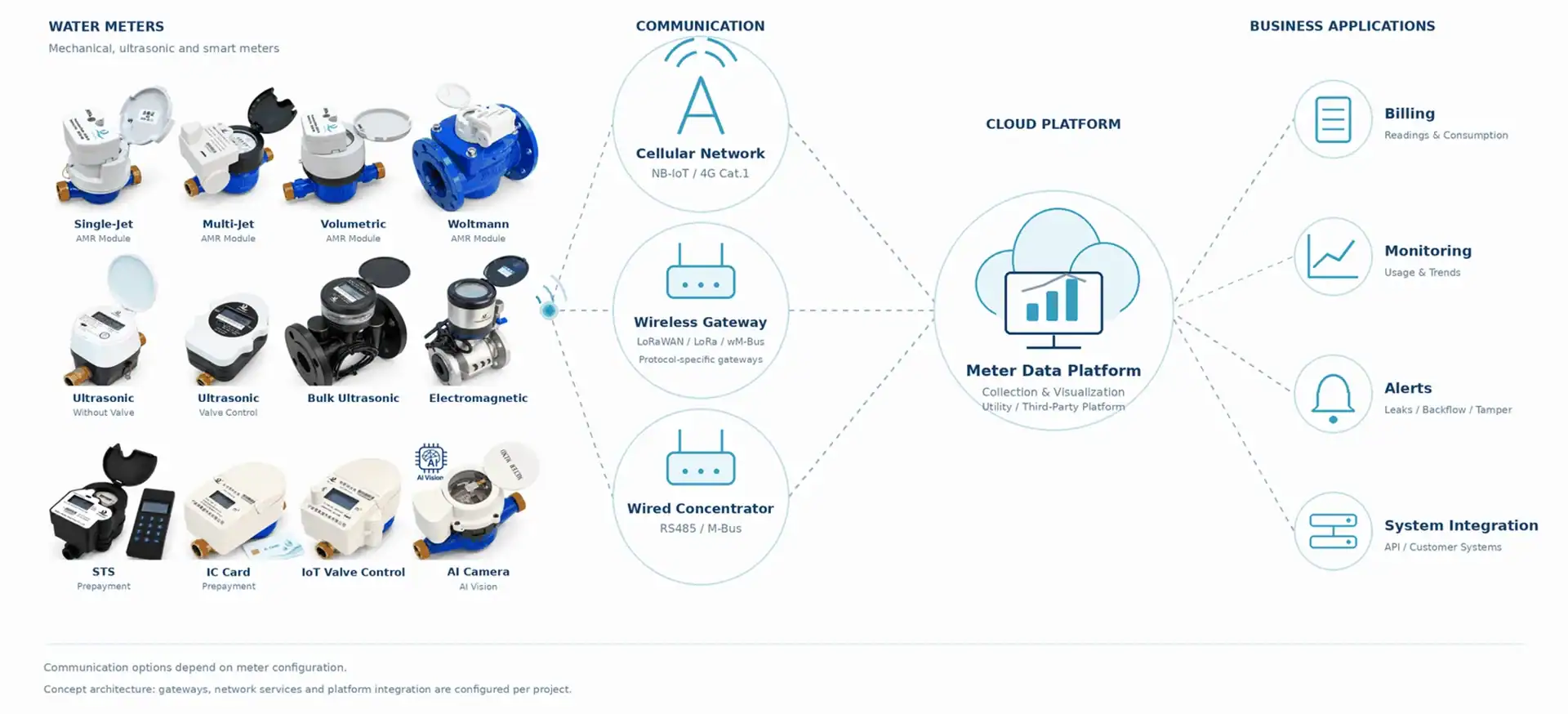
The system has four connected layers. The meter captures consumption, the network transmits the reading, the platform organises the data and the application turns it into useful operational information.
Meter layer — what is being read

Mechanical, ultrasonic and electromagnetic meters provide data through pulse, wired or integrated smart interfaces. Selection depends on pipe size, accuracy and site conditions.
Communication layer — how the reading travels

NB-IoT, cellular, LoRaWAN/LoRa, wireless M-Bus, Wi-Fi or wired links carry readings to the platform. Choose according to coverage, power, frequency and cost.
Platform layer — where data becomes usable

The platform organises readings and device status into records, trends, alerts and reports, with optional billing or management-system integration.
Application layer — what the data drives

Use the data for remote reading, billing, consumption analysis, exception monitoring, maintenance and management reporting.
WHAT AUTOMATIC READING CHANGES FOR A UTILITY
Manual reading provides occasional snapshots and requires repeated field work. Automatic reading improves data availability and allows teams to focus on exceptions instead of visiting every meter.
Visibility
Access readings and meter status without waiting for the next manual route.
Billing accuracy
Reduce transcription errors and keep a clearer history for customer enquiries.
Faster response
Identify missing data or unusual consumption earlier and direct investigation where needed.
Lower field cost
Reduce repetitive visits and reserve field time for installation, inspection and service.
AMR OR AMI — WHAT IS THE DIFFERENCE?
| AMR — Automatic Meter Reading | AMI — Advanced Metering Infrastructure | |
| Data flow | One way: meter → utility | Two way: meter ⇄ utility |
| Reading rhythm | Scheduled reads over a walk-by, drive-by or fixed network | Frequent or on-demand reads, close to real time |
| Control and prepayment | Possible where valve-control meters are fitted | Supported as standard where two-way meters and networks are deployed |
| Typical first step | Replacing manual reading, improving billing accuracy, seeing consumption | Active network management, prepayment, faster leak and tamper response |
| Hardware | Mechanical, ultrasonic or electromagnetic meter with an AMR module | Meters plus two-way communication plus platform integration |
Manual reading provides occasional snapshots and requires repeated field work. Automatic reading improves data availability and allows teams to focus on exceptions instead of visiting every meter.
CHOOSING THE COMMUNICATION PATH
| Option | How the data travels | Where it fits |
| NB-IoT (3GPP Rel-13/14) | Direct to the mobile network, no on-site gateway | Deep indoor and pit installations, low power, long battery life; band set matched to the target market |
| 4G Cat.1 | Direct to the mobile network | Higher throughput and lower latency when readings are denser or near real time |
| LoRaWAN / LoRa | Through a LoRaWAN gateway | Projects that prefer a private network operated on site |
| Wireless M-Bus (wM-Bus) | Through a wM-Bus collector or gateway | Dense meter rooms and walk-by or drive-by reading rounds |
| M-Bus / RS-485 | Through a wired concentrator | Buildings and industrial cabinets where cabling already exists |
There is no single best network. The right choice depends on meter depth, gateway availability and existing utility infrastructure. A hybrid design is often most practical, allowing different communication methods to report to the same platform.
METERS THAT CAN CARRY AN AMR MODULE
The AMR module fits the meter families we already build and ship, so a project can mix sizes and types without splitting the data path.
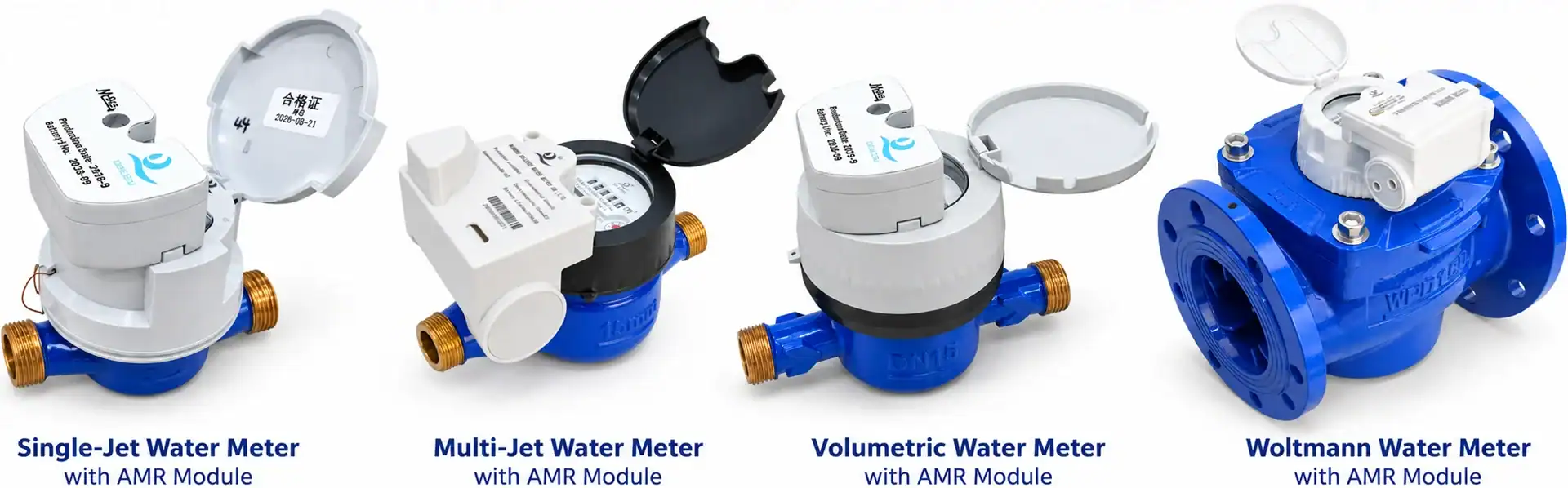
Figure 2 — AMR-fitted mechanical meters: single-jet, multi-jet, volumetric and Woltman.
There are two ways a meter gets onto the network. A mechanical meter keeps its metrology and receives an AMR module; an ultrasonic or electromagnetic meter is electronic by design and carries the communication module inside the meter itself.
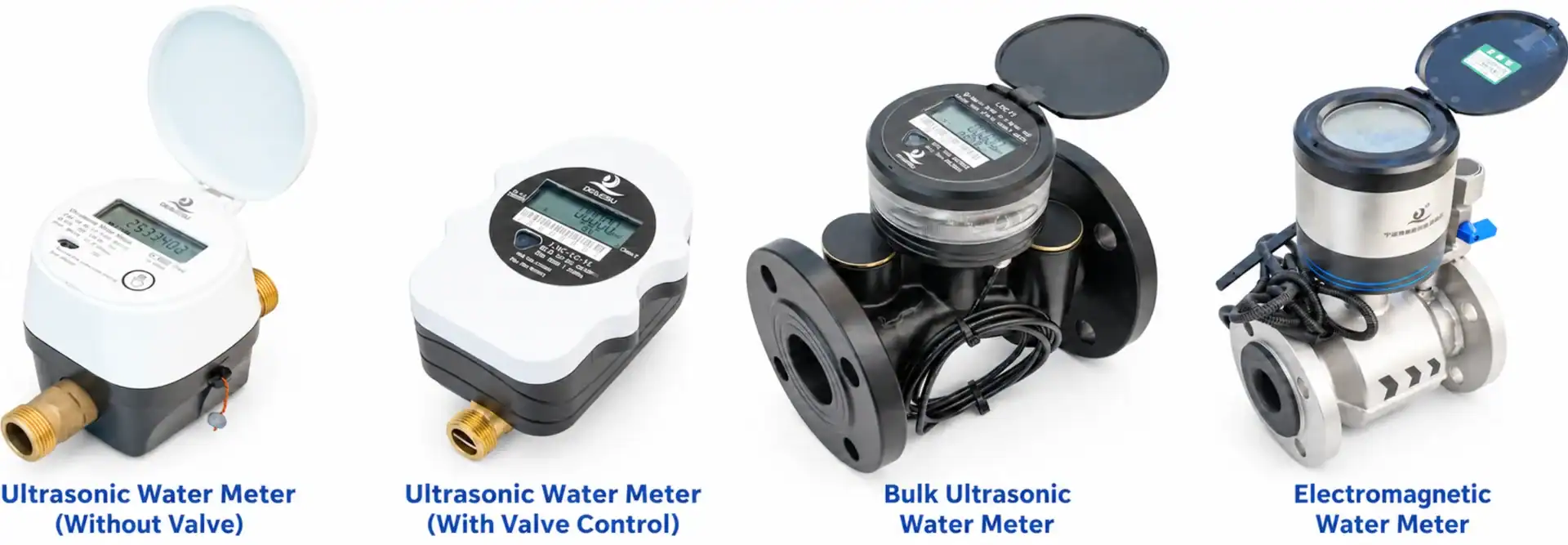
Figure 3 — Ultrasonic and electromagnetic meters with a built-in electronic communication module: valve-free, valve-control, bulk ultrasonic and electromagnetic.
Both routes end in the same place: the reading reaches the platform through the same data path, so a project can mix AMR-fitted mechanical meters with built-in electronic meters and still read them as one fleet.
Typical NB-IoT configuration (model dependent):
- NB-IoT bands and SIM/APN settings matched to the target market
- 3.6 V, 8,500 mAh battery with ≥6-year service life
- Configurable 1-, 6- or 24-hour reporting intervals
- Volume, battery, signal and meter-status reporting
- IP68 protection with optional valve control and alarm functions
WHAT THE PLATFORM SHOWS YOU
The platform is where the data becomes operational. For each meter it holds the identity, location and metrological data; for the fleet it turns readings into trends, alerts and exportable reports.
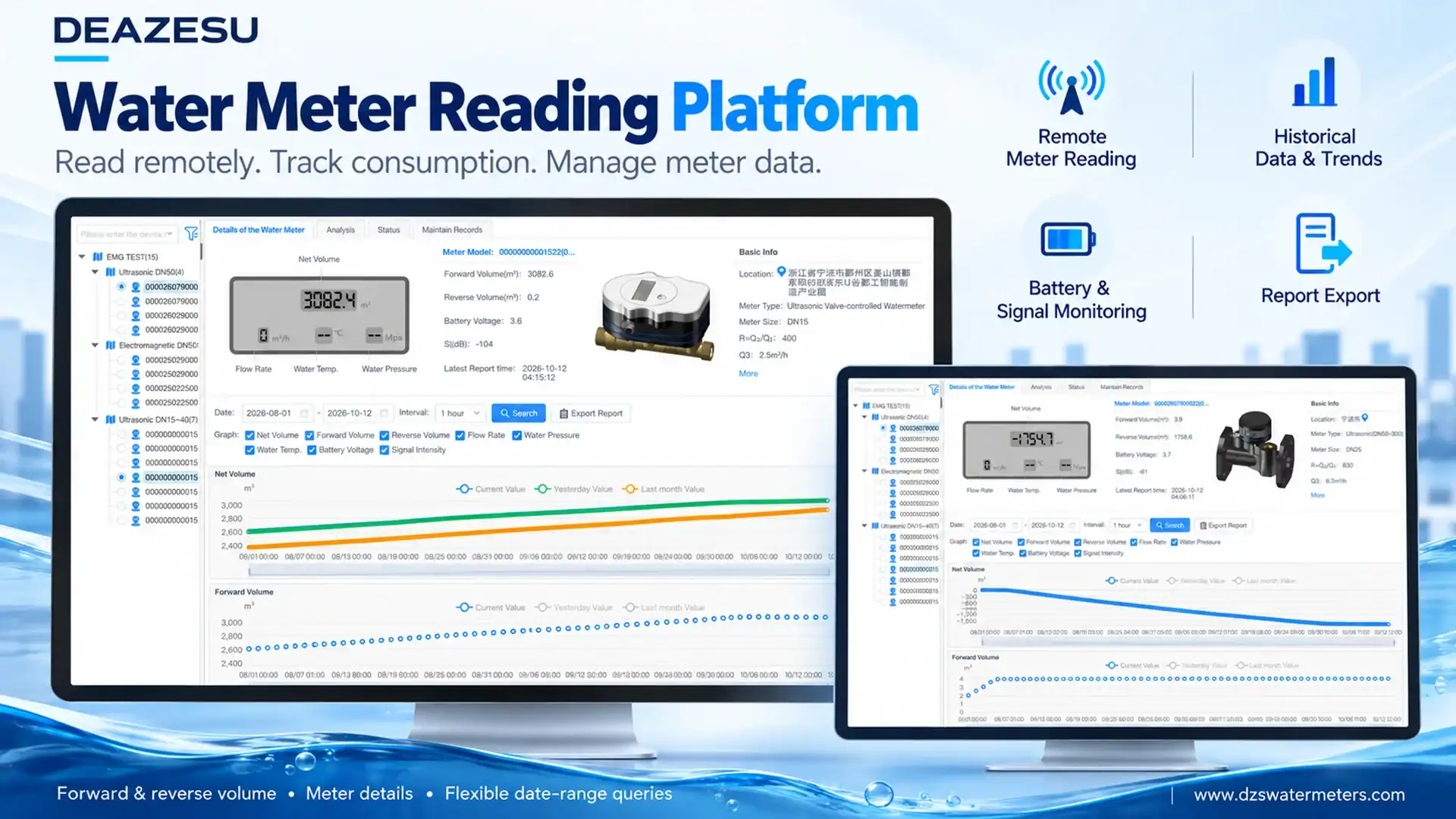
Figure 4 — Meter data platform: device tree, meter details, consumption trends and report export.
Meter details
Volume, battery, signal, specifications, location and latest report time.
Flexible queries
Select any date range and reporting interval.
Usage trends
Compare net and forward volume by day or month.
Report export
Export data for billing, analysis or field follow-up.
Additional data
View temperature and pressure with volume data where supported.
Fleet navigation
Find meters quickly by type and nominal size.
THREE DEPLOYMENTS WE SEE MOST OFTEN
Municipal and district metering
Use operator networks or managed gateways to collect data from meters distributed across a service area.
Apartment and commercial buildings
Use local gateways, wireless M-Bus, LoRa or wired communication where meters are concentrated.
Industrial and facility monitoring
Connect meters to a local management or control system through the appropriate field interface.
FROM PROJECT BRIEF TO LIVE READINGS
Review the site
Confirm meter types, quantities, locations, network coverage, power conditions and reporting goals.
Configure and test
Select the communication route, prepare the devices and validate sample readings.
Deploy and manage
Install by zone, verify data quality, train users and define the support process.
FREQUENTLY ASKED QUESTIONS
| Question | Answer |
| What is the difference between AMR and AMI? | AMR automates reading and sends data one way, from meter to utility. AMI adds two-way communication, which allows remote valve control, prepayment and faster response to leaks and tampering. |
| Does the system need a gateway on site? | Not always. NB-IoT and 4G Cat.1 meters connect directly to the mobile network. LoRaWAN, LoRa and wireless M-Bus need a gateway or collector; M-Bus and RS-485 use a wired concentrator. |
| Can the readings go into our existing billing system? | Yes. The platform collects and visualises the data, and an API integration passes readings into the utility’s or the customer’s own systems. |
| Can AI-camera reading be added to meters already in the field? | Yes — AI-camera remote reading is designed for installed meters, so a fleet can be brought onto the platform without replacing the meters first. |
| How often does a battery-powered meter report? | A typical NB-IoT configuration reports once a day by default, configurable to 1, 6 or 24 hours, with a battery life of six years or more at the default interval. More frequent reporting shortens battery life. |
SEND US YOUR PROJECT
Tell us the target market, the meter types and sizes, the quantity and the network conditions. We will come back with a configuration proposal, the matching datasheets and samples for field validation.
Contact Us