Use the exact U/D rating for your meter—not a universal 10D/5D rule. ISO/OIML classes range from U0/D0 to U15/D5, and an “S” means a straightener is required. Here is how to read, calculate, and apply them.
Is 10D Upstream and 5D Downstream Always Required?
No. The familiar 10D upstream and 5D downstream layout is a conservative rule used in many specifications, but it is not correct for every water meter.
The required length depends on the approved flow-profile sensitivity class, meter technology, nearby disturbances, local regulations, and the manufacturer’s installation drawing.
| Document | What it decides | Your priority |
| Type approval or certificate | Approved U/D sensitivity class and orientation | Confirm it covers the exact model and DN size |
| Manufacturer drawing | Length, reference points, straightener, valves, and supports | Build the meter run to this drawing |
| Local utility or regulation | Minimum site rules, inspection, and commissioning | Apply stricter mandatory requirements |
What U and D Sensitivity Classes Mean
U identifies the required upstream straight length. D identifies the downstream length. The number is the required multiple of nominal diameter, while the suffix “S” means a flow straightener is needed.
| Side | Available classes | Straightener |
| Upstream | U0, U3, U5, U10, U15 | No |
| Upstream | U0S, U3S, U5S, U10S | Yes |
| Downstream | D0, D3, D5 | No |
| Downstream | D0S, D3S | Yes |
For example, U10/D5 means ten nominal diameters upstream and five downstream without a straightener. U5S/D3S requires five and three diameters plus the specified straightener.
U0/D0 removes the straight-length requirement for the evaluated sensitivity class. You must still keep the pipe full, follow the flow arrow, use an approved orientation, and meet local installation rules.
The class addresses sensitivity to velocity-field irregularity, not every installation risk. It does not approve partly filled pipe, trapped air, sediment, unsupported pipework, or an unapproved mounting position.
How to Calculate Straight Pipe Length
Use the approved multiplier and the diameter basis stated in the meter documentation. ISO/OIML classes are expressed as multiples of DN.
- Upstream length = U multiplier × DN
- Downstream length = D multiplier × DN
- Total reserved space = upstream run + meter lay length + downstream run + service clearance
A DN50 meter rated U10/D5 needs 500 mm upstream and 250 mm downstream. Add the meter body length, flange or union allowance, and room for bolts, tools, and removal.
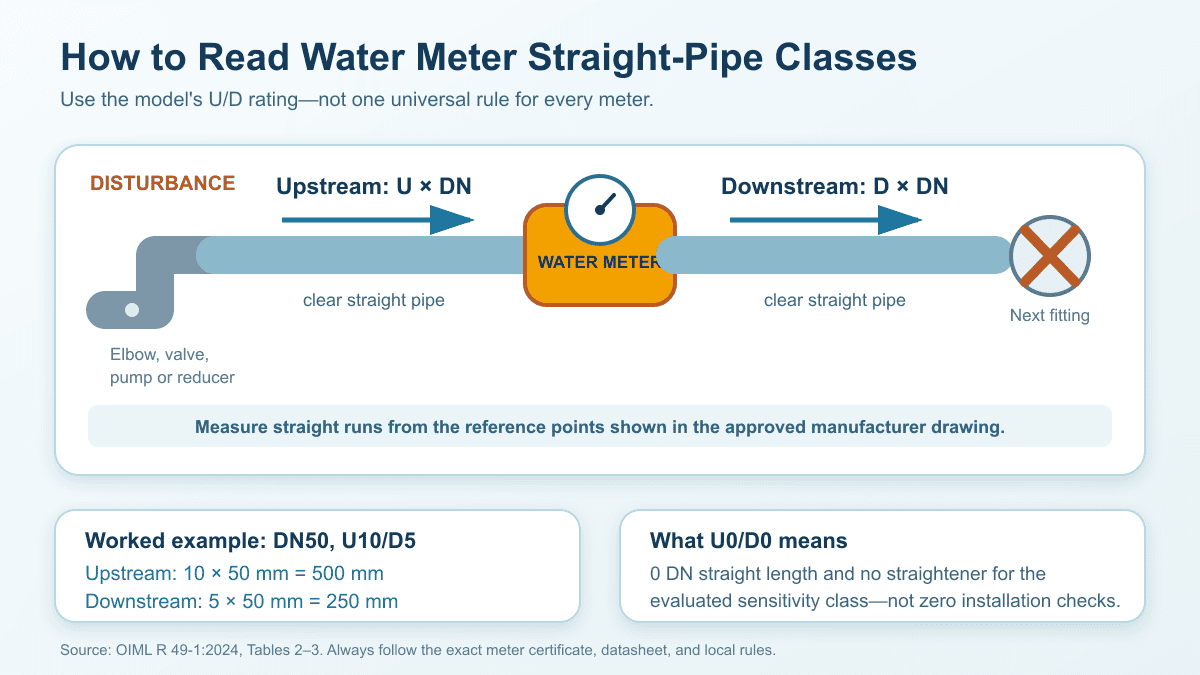
Do not measure automatically from the meter centerline. Use the connection face or other reference point shown on the approved installation drawing.
Which Components Disturb the Flow Profile?
Flow needs distance to recover after a fitting changes velocity or creates swirl. Upstream disturbances usually matter more because the altered profile reaches the measuring element directly.
| Component | Potential effect | Installation response |
| Elbow or two out-of-plane elbows | Asymmetric flow and swirl | Keep outside the specified upstream zone |
| Partly closed valve | Jetting and severe velocity distortion | Use an approved valve type and normal operating position |
| Pump | Pulsation, vibration, and unstable flow | Follow the meter and pump layout instructions |
| Reducer or expander | Acceleration, separation, or uneven velocity | Use the required transition and separation distance |
| Strainer, check valve, or backflow device | Pressure loss and local turbulence | Place only where the approved drawing permits |
A fully open, full-bore isolation valve generally creates less disturbance than a throttled valve. However, “fully open” does not cancel the documented separation distance or make every valve interchangeable.
Straight-Run Needs by Water Meter Type
Technology suggests how sensitive a meter may be, but it does not replace the documented U/D class.
- Turbine and Woltman meters: often benefit from a developed velocity profile and careful upstream layout.
- Multi-jet and single-jet meters: check the approved orientation, strainer arrangement, and model-specific straight run.
- Volumetric meters: may tolerate disturbed flow differently, yet debris, air, and orientation still matter.
- Ultrasonic and electromagnetic meters: some models are approved as U0/D0, while others still require straight pipe.
For a verified example, our DN50 ultrasonic bulk water meter is specified as U0/D0. That rating belongs to this model; it is not a blanket rule for all ultrasonic meters.
When comparing models, request the U/D rating for the exact size and configuration. A product family can include different body lengths, sensors, firmware, approvals, or hydraulic designs.
Water Meter Installation Checklist
- Confirm the exact model, DN size, U/D class, approved orientation, and flow direction.
- Mark every elbow, valve, reducer, pump, strainer, and backflow device near the meter.
- Calculate the required clear lengths and reserve the meter lay length separately.
- Use the specified straightener when the class contains “S”; do not substitute an unapproved device.
- Support and align the pipe so flanges or unions do not pull the meter into position.
- Flush the line before fitting the meter and prevent debris from entering the body.
- Fill the pipe slowly, vent trapped air, inspect for leaks, and verify the first reading.
- Record the installed layout, model, serial number, settings, and commissioning result.
After commissioning, record a stable baseline reading and compare it with the expected demand. Unexpected oscillation, reverse registration, or zero flow deserves investigation before the installation is accepted.
FAQs about Water Meter Straight Pipe Requirements
Does every water meter need 10D upstream and 5D downstream?
No. Use the meter’s certified U/D class and installation drawing. A local regulation may impose a stricter minimum.
What does U0/D0 mean on a water meter?
It means zero nominal diameters of straight pipe are required upstream and downstream for the evaluated flow-profile sensitivity class, with no straightener required.
Can a flow straightener replace missing straight pipe?
Only when the approved class or manufacturer explicitly requires or permits that straightener. An arbitrary device can add pressure loss or create a different disturbance.
Where should the straight-pipe measurement start?
Follow the manufacturer’s drawing. It commonly starts at a meter connection face, but the approved reference point—not a generic assumption—controls the measurement.
Plan Your Meter Run with DEAZESU
We manufacture mechanical, smart, ultrasonic, and electromagnetic water meters for residential, commercial, industrial, and utility projects.
Compare our water meter range, then send your DN size, pipe layout, nearby fittings, flow range, and required approval through our contact page. We will help you review a suitable model and installation arrangement.