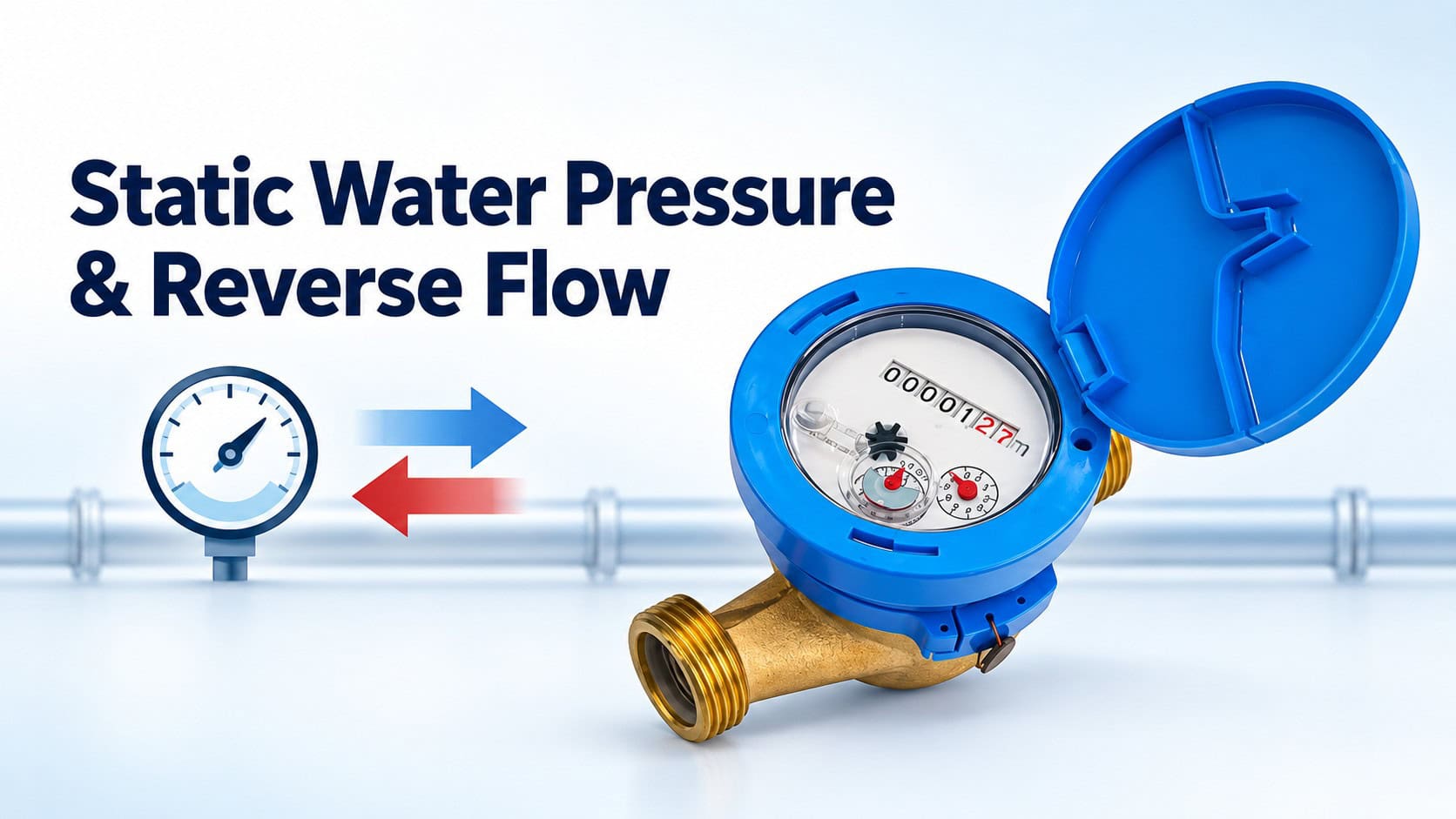
Static water pressure shows the system at rest. It does not reveal flow direction by itself, but pressure differences around the meter can trigger reverse flow, billing errors, alarms, or backflow risk.
What Static Water Pressure Tells You
Static pressure is measured when water is not moving. With no flow, there is no meter pressure-loss component caused by friction.
Residual pressure is measured while water flows. It is lower because pipes, fittings, valves, backflow devices, and the meter consume part of the available pressure.
| Reading | System condition | What it can reveal | What it cannot prove |
| Static pressure | No intended flow | Resting pressure, elevation effects, possible overpressure | Meter pressure loss or available flow |
| Residual pressure | Known flow is occurring | Pressure remaining under demand | Why pressure is lost without further checks |
| Differential pressure | Compared across the meter | Likely flow direction and restriction | Accurate volume unless the meter is approved for that direction |
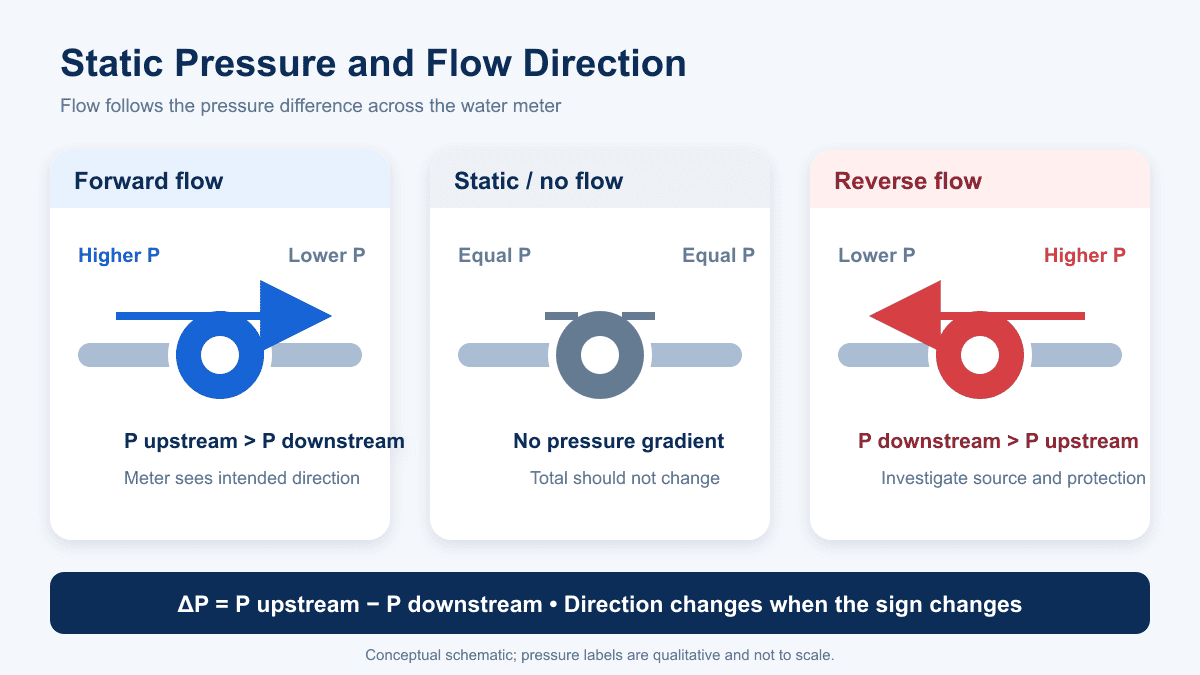
How Static Pressure Becomes Reverse Flow
Water normally moves from higher pressure to lower pressure. When downstream pressure exceeds upstream pressure, the pressure gradient reverses and water can pass backward through the meter.
Two conditions commonly create that reversal:
- Backsiphonage: supply pressure drops because of a main break, pump outage, hydrant use, firefighting demand, or rapid network withdrawal.
- Backpressure: a downstream pump, elevated tank, boiler, thermal expansion, or another pressurized source exceeds supply pressure.
A brief negative event may be harmless oscillation. Sustained reverse volume near an unprotected cross-connection can become a water-quality and network-control issue.
Which Water Meters Measure Reverse Flow?
Backward movement does not automatically mean accurate reverse measurement. Meter design, approval, register logic, and communication fields must support the reverse direction.
| Meter capability | Possible response | What you should verify |
|---|---|---|
| Designed to measure reverse flow | Subtracts reverse volume or records it separately | Reverse measuring range, accuracy, totals, and data output |
| Not designed to measure reverse flow | Prevents it or withstands accidental reversal | Check valve arrangement and reverse-flow withstand rating |
| Directional meter installed backward | Normal demand appears as reverse flow | Body arrow, inlet, outlet, orientation, and commissioning record |
OIML R 49-1:2024 requires a reverse-measuring meter to meet its applicable error limits in both directions. A non-measuring meter must prevent reverse flow or withstand accidental reverse flow up to Q3 without deterioration.
For a broader meter-by-meter comparison, see our guide to water meters running backward and measuring reverse flow.
Three Ways to Handle Reverse Volume
| Method | Billing result | Diagnostic value | Best fit |
| Subtract | Reverse volume reduces the forward total | Limited unless events are also stored | Systems that need net transfer |
| Record separately | Forward and reverse totals remain independent | High; direction, duration, and net volume remain visible | AMI, network diagnostics, and dispute review |
| Prevent | No intended reverse passage | Depends on pressure and valve monitoring | Cross-connection control and protected services |
Measurement and prevention are different functions. A bidirectional meter can document reverse flow, but it is not automatically an approved backflow-prevention device.
How Smart Water Meters Generate Reverse-Flow Alarms
A smart meter, encoder, or meter interface unit detects negative signed flow. The device or platform then checks magnitude and duration before raising an event.
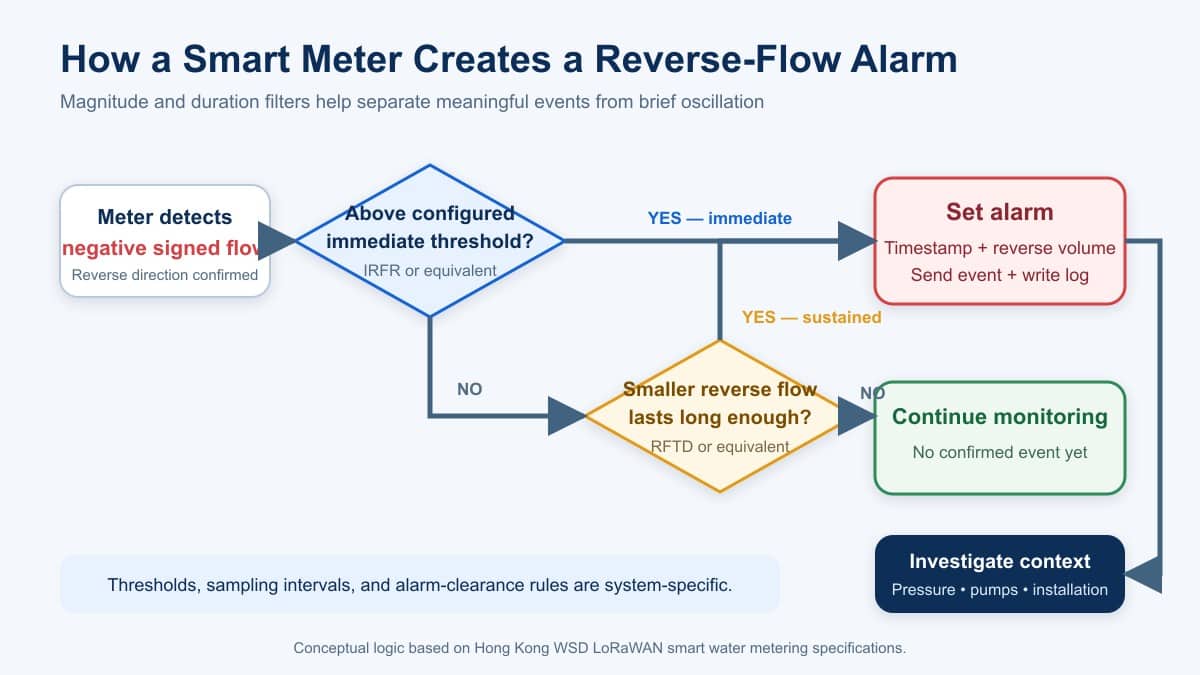
The WSD specification illustrates two useful filters: immediate confirmation above a configured reverse-flow threshold, or confirmation after smaller reverse flow persists beyond a duration threshold.
- Store the event start, duration, reverse volume, and clearance time.
- Transmit the alarm to the AMR or AMI platform for investigation.
- Use thresholds to reduce alerts from brief pressure pulses or oscillation.
Alarm logic is configurable. Never assume one manufacturer’s threshold, sampling interval, or clearance rule applies to another meter.
Two Pressure and Installation Cases
Case 1: Network Pressure Drops
A pump trip or high fire-flow demand lowers upstream pressure. A building tank, booster, or elevated pipework then becomes the higher-pressure side.
The meter may register reverse volume, while an unprotected cross-connection can return non-potable water toward the main. Check pressure logs, nearby alarms, pumps, and backflow devices together.
Case 2: The Meter Is Installed Backward
Normal consumption passes against the arrow, so a directional smart meter reports persistent reverse flow. A mechanical register may count backward, stall, or produce unreliable totals.
Do not solve this by changing alarm thresholds. Isolate the service safely, confirm the flow arrow, reinstall correctly, and verify both the local register and remote data.
Check Pressure Before Commissioning
- Record upstream and downstream static pressure with all intended demand stopped.
- Repeat under a known flow and document residual pressure plus flow rate.
- Confirm the meter arrow, orientation, straight lengths, valves, and backflow assembly.
- Verify whether reverse volume is subtracted, separated, blocked, or ignored.
- Test alarm generation, communication, event timestamps, and alarm clearance.
Also check maximum admissible pressure, or MAP. OIML R 49 specifies static tests at 1.6 times MAP for 15 minutes and twice MAP for one minute without leakage or damage.
Ratings remain model-specific. For example, our DN15–DN25 ultrasonic meter with valve lists MAP16 and continuously measures forward and reverse volume, with Class 2 reverse-measurement performance.
FAQs about Static Water Pressure at a Water Meter
Can a water meter read pressure?
Most conventional water meters measure volume, not pressure. Pressure requires a gauge, transducer, or an integrated pressure-sensing model.
Does high static pressure cause reverse flow?
Not by itself. Reverse flow requires the downstream side to exceed upstream pressure, or the supply side to fall below the connected source.
Can static pressure change the meter reading?
Totalization should not change without flow. Movement at zero demand suggests oscillation, leakage, thermal expansion, air, reverse flow, or an installation problem.
Is a reverse-flow alarm proof of contamination?
No. It proves that the configured detection rule was met. Inspect the pressure event, duration, cross-connections, backflow protection, and installation direction.