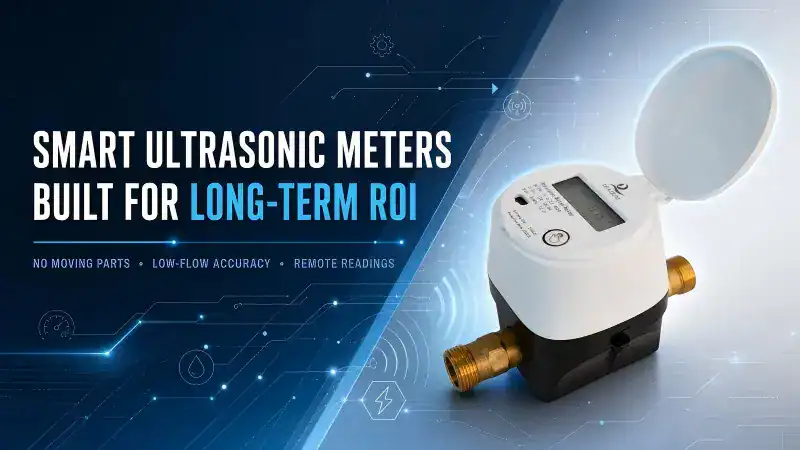
A mechanical meter may cost less on day one, but purchase price is only one part of the investment. A smart ultrasonic system can deliver stronger long-term ROI through stable measurement, low-flow sensitivity, fewer service visits, remote meter readings, and earlier leak detection.
Ultrasonic vs Mechanical Meters: How Technology Affects ROI
The main difference is how each meter measures water.
A mechanical meter uses moving parts such as a turbine or piston. An ultrasonic meter uses sound waves, so no mechanical measuring parts need to rotate.
This difference affects accuracy, maintenance, and long-term cost.
How an Ultrasonic Water Meter Works
An ultrasonic water meter sends sound pulses through the water.
It compares how long the pulses take to travel upstream and downstream. The meter then uses this time difference to calculate water velocity, flow rate, and total consumption.
Because the measurement is electronic, there is no friction between moving components. This helps the meter stay accurate across a wider flow range, including very low flow.
How a Mechanical Meter Works
A mechanical meter uses a turbine, multi-jet mechanism, or measuring chamber.
Water physically moves these components, and the meter converts that movement into a consumption reading.
This design is simple and often has a lower upfront cost. However, sand, scale, hard water, and mechanical wear can gradually reduce performance.
As resistance increases, the meter may miss low flow and under-record water use.
Why Moving Parts Increase Long-Term Costs
A new mechanical meter may be accurate. The real question is whether it can maintain that accuracy after years of use.
Moving parts are affected by:
- Wear and tear
- Sediment buildup
- Scale
- Turbine resistance
- Aging materials
These issues can reduce low-flow sensitivity and lead to unrecorded consumption.
An ultrasonic meter has no moving parts in its measuring system. This reduces mechanical drift and supports better long-term accuracy.
Stable accuracy helps protect revenue.
When a meter continues to record small flows correctly, you improve billing accuracy and reduce apparent water loss.
Across hundreds or thousands of connections, even small under-registration losses can add up to significant non-revenue water.
Key advantages of ultrasonic technology include:
- No turbine or piston wear
- Better low-flow sensitivity
- Less mechanical maintenance
- Fewer accuracy changes caused by wear
- Consistent digital data for billing and analysis
However, not all ultrasonic meters perform the same.
You should still compare water quality requirements, installation conditions, battery life, communication options, accuracy class, and certifications.
Choose the meter based on its full specification, not only the word “ultrasonic.”
Leak Detection and Smart Technology Protect Revenue
A smart meter creates value beyond precise measurement. It turns consumption into usable data.
With scheduled or frequent meter readings, your team can identify continuous overnight flow, reverse flow, abnormal usage, or sudden changes. These patterns support leak detection before a customer reports a high bill or a visible pipe failure.
A traditional device with a manual register may record the same event, but the information often remains unseen until the next reading cycle.
Smart technology shortens the gap between abnormal flow starting and your team taking action.
For utilities, property managers, and commercial users, faster alerts can help:
- Reduce lost water and treatment costs
- Limit property damage
- Resolve billing disputes with clearer data
- Prioritize inspections and maintenance
- Support sustainable water management practices
DEAZESU water meters can support remote reading, leak monitoring, and non-revenue water management. Its systems include NB-IoT, LoRa, and 4G communication options for different deployment needs.
You can learn more in the DEAZESU guide on reducing non-revenue water with smart water meters.
Total Cost Comparison for Residential and Commercial Meter Projects
A mechanical model often has a lower initial cost. That can make it attractive for a small project or a system where manual reading is already efficient.
However, long-term ROI should include every cost created during the meter’s operating life.
| Cost or Value Factor | Smart Ultrasonic Meter | Mechanical Model |
| Initial purchase | Usually higher | Usually lower |
| Sensing method | Sound waves and electronic sensing | Turbine, piston, or rotating mechanism |
| Moving parts | None in the measuring principle | Yes |
| Low-flow accuracy | Typically stronger across a wider range | Can decline as components age |
| Meter readings | Remote options available | Often manual unless an AMR module is added |
| Leak detection | Data-based alerts and continuous-flow analysis | Limited without connected technology |
| Maintenance | Less maintenance from mechanical wear | Cleaning, testing, or replacement may increase |
| Long-term value | Higher potential through data and stable accuracy | Strongest where simplicity and low upfront cost matter |
Mechanical models generally offer a lower upfront investment, while connected ultrasonic systems can reduce reading labor, maintenance requirements, water loss, and under-registration over time.
Calculate ROI Beyond the Purchase Price
For a fair comparison, calculate the total cost of ownership for the expected project period:
Total ownership cost = purchase + installation + reading labor + communications + maintenance + calibration + replacements + lost revenue from under-registration.
Then add measurable benefits such as improved billing, lower reading labor, faster response, and better water efficiency.
The advantages of ultrasonic systems become clearer when labor is expensive, access is difficult, or small losses add up. A meter that costs more initially may still produce the lower lifecycle cost.
When comparing products, check whether the meter has features that support these long-term savings. For example, DEAZESU’s DN15 R400 residential ultrasonic water meter uses a static design and supports AMR/AMI integration.
Its specifications include an R400 operating range, IP68 protection, Class 2 accuracy, and a battery service life of at least 10 years. These features show how product specifications can directly affect long-term ROI—not just meter performance on the day of installation.
When a Mechanical Meter Still Makes Sense
A mechanical model is not automatically the wrong choice. It may suit projects with:
- A strict upfront budget
- Clean water and stable operating conditions
- Easy access for manual readings
- Limited need for automated alerts or interval data
- An established testing and replacement program
The right decision depends on your application.
For residential and commercial projects, compare expected service conditions, data requirements, accuracy and reliability, and your operational capacity.
Why Ultrasonic Water Meters Deliver Better Long-Term ROI
Ultrasonic water meters outperform many traditional devices because they combine precise water metering with smart management systems.
The benefit is not one dramatic saving. It is the accumulation of smaller gains over time.
You may reduce reading labor, capture more low-flow consumption, detect a leak earlier, avoid repeated service calls, and make replacement planning more predictable.
Together, these improvements can offset the higher initial cost and create a stronger return.
The best ROI comes from matching the device to the system. Review the following factors before selecting a model:
- Pipe diameter and connection type
- Minimum and permanent flow
- Water temperature and pressure
- Water quality and sediment levels
- Network coverage
- Battery expectations
- Installation conditions
- Required certifications
- AMR or AMI integration requirements
Do not evaluate a meter based only on its unit price. A cheaper product can become expensive when it creates more field visits, inaccurate data, missed consumption, or early replacement.
FAQs about Smart Ultrasonic Meters vs Mechanical Meters
Why Are Ultrasonic Water Meters More Accurate at Low Flow?
An ultrasonic unit measures changes in the travel time of sound waves rather than waiting for water to overcome mechanical resistance.
This makes ultrasonic devices sensitive to lower movement and helps them record small consumption or a slow leak that an aging mechanical device may miss.
Do Ultrasonic Meters Require Calibration?
Every device should follow the manufacturer’s verification and calibration requirements.
However, solid-state sensing removes the moving components that commonly change mechanical performance. Correct installation, programming, water conditions, and periodic system checks remain important.
Are Ultrasonic Meters Maintenance-Free?
They generally require less maintenance because the sensing method has no moving parts.
However, “maintenance-free” should not be treated as an absolute promise. Batteries, communications, seals, installation conditions, and electronic diagnostics still need to be considered during lifecycle planning.
Can a Smart Ultrasonic Meter Detect Every Leak?
A connected ultrasonic device can identify continuous or unusual flow patterns and generate alerts when configured correctly.
It cannot locate every pipe defect by itself. Your team may still need pressure testing, acoustic testing, or a physical inspection to confirm the leak location.
Which Meter Is Better for a Large Utility Upgrade?
For a large utility, ultrasonic technology often offers greater value where remote reading, low-flow accuracy, anomaly alerts, and long-term accuracy are priorities.
A phased pilot can confirm communications performance, installation requirements, data quality, and lifecycle cost before full deployment.
Is a Higher R Ratio Always Better?
A higher R ratio indicates a wider range between the permanent flow and minimum flow specified for the meter. This can support better low-flow recording.
However, you should also review actual accuracy limits, installation requirements, communications, battery life, pressure loss, environmental protection, and certification.
Choose a Reliable Ultrasonic Meter Supplier
DEAZESU is a water-meter manufacturer with more than 20 years of industry experience, in-house production and testing capabilities, OEM/ODM support, and mechanical, smart, ultrasonic, and electromagnetic product options.
The company supports residential, commercial, and utility water management projects with remote reading and IoT connectivity solutions.
If you are looking for a reliable ultrasonic water meter manufacturer and supplier, contact DEAZESU to discuss your flow range, communication method, certification, and project requirements.