A small hydraulic drop can affect downstream pressure, pumping cost, and user experience. When you choose a meter for a building, utility, or industrial project, you need to know how much resistance it adds and whether that value stays acceptable at peak demand.
What a Meter Pressure Drop Really Means
The drop is the difference between inlet and outlet pressure while water passes through the measuring unit. The device creates resistance because the moving liquid meets internal channels, strainers, measuring chambers, turbines, pistons, or sensors.
You can think of it as the hydraulic price paid for measurement. A small reduction is normal. An excessive reduction can limit available pressure at taps, equipment, irrigation points, or production lines.
This matters most when the original water supply is already weak, the pipeline is long, or several devices are installed in series. In these cases, even modest resistance may become noticeable during periods of high demand.
Common Pressure Units
Project documents may express the result in several units:
- kPa: common in ISO and OIML documentation
- bar: widely used in international engineering
- MPa: often shown on technical data sheets
- psi: frequently used in North American specifications
For quick comparison, 0.063 MPa equals 63 kPa or 0.63 bar.
How Flow and Meter Design Change Hydraulic Resistance
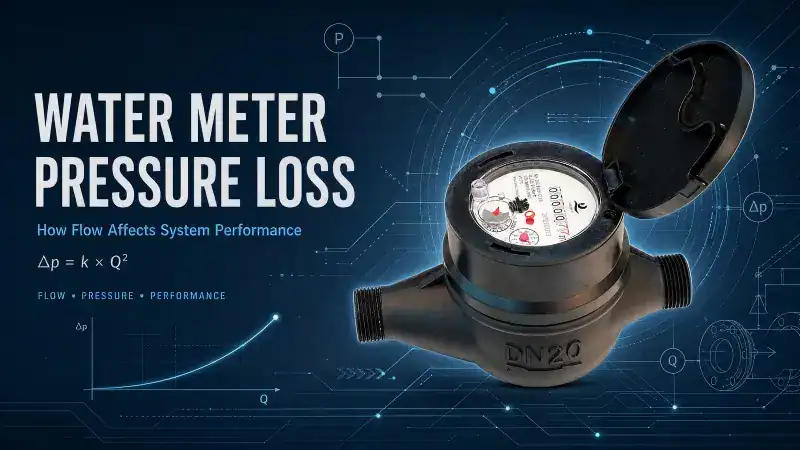
For a fixed meter design, the pressure drop generally rises much faster than the rate passing through the pipe. A useful simplified relationship is:
Δp = k × Q²
Here, Δp is the pressure difference, Q is the volumetric rate, and k represents the resistance created by the internal structure.
That square relationship matters. If Q doubles, the pressure drop may increase to roughly four times the original value. A unit that performs comfortably during average demand may therefore become restrictive near Q3 or during short peak periods.
The following factors usually have the greatest influence:
| Factor | Why It Matters |
| Nominal diameter | An undersized unit increases velocity and resistance |
| Internal design | Narrow passages and sharp direction changes create turbulence |
| Measuring principle | Moving parts and measuring chambers can add obstruction |
| Strainer condition | Debris or scale reduces the available passage |
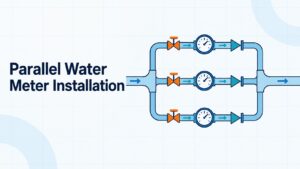
| Installation layout | Nearby bends, valves, and pumps can disturb the velocity profile |
| Operating rate | Higher demand produces a steeper pressure drop |
Mechanical, Ultrasonic, and Electromagnetic Options
Mechanical models may use impellers, turbines, or pistons. These proven technologies can provide dependable measurement, but their internal components create hydraulic resistance.
Ultrasonic and electromagnetic models can offer a smoother passage because they measure without a conventional rotating mechanism. However, you should not assume every electronic model automatically has low pressure loss. Always compare the declared class, Q3 value, bore geometry, and test curve.
DEAZESU supplies mechanical, AMR, ultrasonic, and electromagnetic options, so buyers can compare technologies against actual project conditions rather than selecting by price alone.
Pressure Loss Standards and Classes
OIML R 49-1:2024, the international metrology standard specifying the metrological and technical requirements for water meters, states that the hydraulic drop through a complete unit, including an integral filter or strainer, must not exceed 0.063 MPa between Q1 and Q3. It also defines several classes that manufacturers may declare.
| Class | Maximum Pressure Loss | Approximate Bar |
| Δp63 | 63 kPa | 0.63 bar |
| Δp40 | 40 kPa | 0.40 bar |
| Δp25 | 25 kPa | 0.25 bar |
| Δp16 | 16 kPa | 0.16 bar |
| Δp10 | 10 kPa | 0.10 bar |
A lower class number means less hydraulic resistance. That does not automatically mean better measurement accuracy, because accuracy and resistance are separate performance indicators.
For projects based on an AWWA standard, requirements may be stated in psi and may vary with device type, size, and rated capacity. Ask the supplier to identify the applicable AWWA document and provide corresponding test data instead of relying on a generic claim.
How to Choose the Right Meter for Your Water System
Start with the real operating conditions, not only the pipe diameter. The best selection keeps the normal operating point within the efficient range while preserving enough downstream pressure during peak use.
Before requesting a quotation, provide:
- Pipe size and connection type
- Expected minimum, normal, and peak rates
- Available inlet pressure
- Required downstream pressure
- Water quality and expected solids
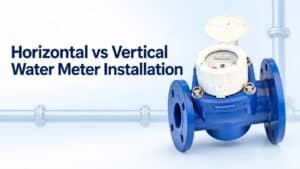
- Horizontal or vertical installation
- Applicable standard and certification
- Communication needs, such as pulse, LoRa, NB-IoT, or 4G
Then ask the manufacturer for the pressure-drop curve rather than one value alone. A single result at Q3 is useful for compliance, but the curve shows how the unit behaves across your expected operating range.
You should also check installation sensitivity. OIML guidance notes that bends, valves, and pumps can disturb the upstream or downstream velocity field. The manufacturer may specify straight pipe lengths or a straightener to maintain performance.
A Practical Buyer Checklist
Use this short comparison when reviewing proposals:
| Question | What to Confirm |
| Is the size correct? | Normal demand should not sit too close to overload conditions |
| Is the class declared? | Look for Δp63, Δp25, Δp16, or another stated class |
| Is test evidence available? | Request a curve or test report for the proposed model |
| Are accessories included? | An integral strainer may be part of the tested result |
| Is water quality considered? | Scale and debris can increase resistance over time |
| Is calibration controlled? | Verify the supplier has suitable test equipment and procedures |
DEAZESU states that its factory includes test-bench lines and calibration capabilities for DN15–40 and DN50–300 products. This is relevant when you need a supplier to verify performance across residential, commercial, or industrial sizes.
FAQs About Water Meter Pressure Loss
Does a Lower Pressure Drop Mean Better Accuracy?
Not necessarily. Hydraulic resistance describes how much energy is lost as water passes through the device. Accuracy describes how closely the registered volume matches the actual volume. You need both an acceptable drop and verified metrological performance.
Why Does Pressure Seem Lower After Installation?
Possible causes include an undersized unit, a blocked strainer, installation debris, partially closed valves, poor pipe alignment, or unusually high demand.
Compare inlet and outlet readings under controlled conditions before blaming the measuring mechanism.
Can the Pressure Drop Increase Over Time?
Yes. Sediment, scale, corrosion products, or aging components can narrow internal passages.
Routine inspection is especially important where the distribution network carries suspended solids or experiences frequent pipe repairs.
How Is the Value Tested?
A test bench measures inlet and outlet pressure at defined operating points. The difference is recorded while the rate is stabilized.
Testing should include relevant accessories and follow the chosen standard, because setup details affect the result.
Find the Right Meter Supplier
DEAZESU manufactures mechanical, smart, ultrasonic, and electromagnetic metering products, with OEM/ODM support, quality-control processes, and smart communication options.
If you are looking for a reliable metering manufacturer or supplier, contact DEAZESU and send your project requirements for a suitable recommendation.