Old pipework does not automatically mean unreliable measurement. Problems usually come from worn equipment, poor sizing, difficult water conditions, or weak maintenance practices. By finding the cause first, you can recover lost consumption, improve billing confidence, and plan upgrades without replacing every device at once.
Why Traditional Water Meters Lose Accuracy
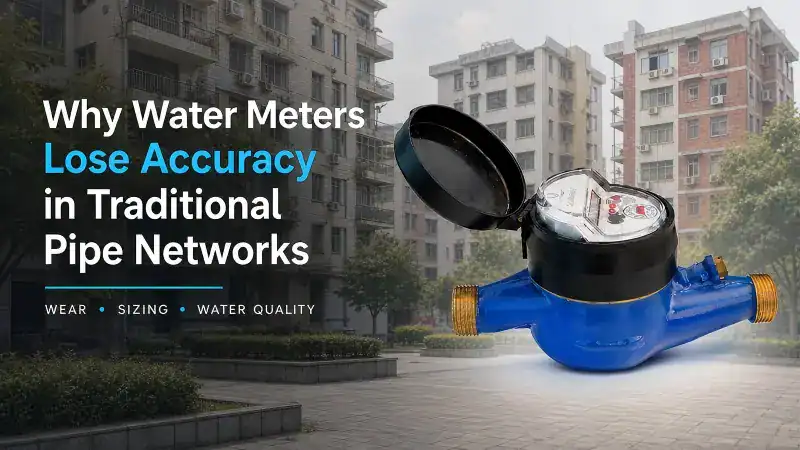
Traditional water meters usually rely on pistons, turbines, or impellers. These moving components can measure reliably when they are correctly sized, installed, and maintained. In an older network, however, several small problems often combine until readings begin to drift.
| Common cause | What happens inside the network | Likely result |
| Mechanical wear | Bearings, turbines, or pistons become less responsive | Under-registration, especially at low demand |
| Sand, rust, or scale | Deposits obstruct or slow moving components | Increasing measurement error |
| Oversizing | Normal demand sits below the meter’s effective range | Small consumption is missed |
| Poor installation | Flow disturbance, air, or incorrect orientation affects measurement | Unstable or inconsistent readings |
| Aging registers | Displays or transmission components become unreliable | Gaps between actual use and recorded use |
Wear, Water Quality, and Age
Sediment and mineral scale do more than create a maintenance nuisance. They add resistance to moving parts. A slow leak or a lightly opened tap may then produce too little force to start the measuring mechanism.
The result is gradual under-registration rather than an obvious failure. That makes the issue easy to overlook. A meter that still displays a reading is not necessarily measuring the full flow.
Aging water meters deserve attention, but replacement decisions should also reflect cumulative volume, water quality, and demand.
Sizing, Installation, and Changing Demand
Oversized water meters are common where a network was designed for future growth or high peak demand. If typical consumption later remains below the intended range, the device may miss low flow for much of the day.
Installation also matters. Disturbed flow, trapped air, debris, reverse installation, and unsuitable upstream pipework can affect performance. Changing building use may also make a once-correct size unsuitable.
How Inaccurate Water Meters Raise Non-Revenue Water
Under-registration creates apparent loss: water is delivered but not fully recorded. For a utility, that difference contributes to non-revenue water and weakens confidence in the water balance.
The financial impact is not limited to one account. Small losses across thousands of connections can distort demand forecasts, revenue projections, and investment decisions. Inaccurate bulk meters can be even more disruptive because each device represents a large share of system input or district flow.
Use these warning signs to prioritize investigation:
- District inflow rises while billed consumption stays flat.
- Similar properties show unusually different usage patterns.
- Manual readings repeat, jump, or conflict with expected demand.
- Night flow remains high without a matching consumption record.
Audit Water Meters Before Replacing Them
A full replacement is expensive and may not solve installation or data problems. First separate device failure from leakage, reading mistakes, account issues, and unauthorized consumption.
Review Meter Data Before Field Visits
Compare meter data with historical use, seasonal demand, customer type, district inflow, and work-order records. Look for flat lines, sudden drops, impossible reversals, repeated estimates, or consumption that no longer matches the property.
Smart analytics can help you rank suspicious accounts, but field checks remain important. Data tells you where to look; inspection tells you why the problem exists.
Test a Representative Sample
Do not test only failed or very old water meters. Sample by age, size, cumulative volume, water quality zone, and customer segment. Include devices that appear normal.
A utility audit can follow this sequence:
- Verify the installation, serial number, seal, and reading.
- Check for bypasses, reverse flow, air, or visible damage.
- Compare on-site flow with the recorded value.
- Bench-test selected devices at multiple flow rates.
- Rank corrective work by financial impact and operational risk.
Select and Manage Water Meters for Real Conditions
The best solution is rarely one product for every connection. Your utility should match the measuring technology, size, communication method, and protection level to the application.
| Network condition | Practical response | Expected benefit |
| Sediment or scale | Improve flushing or filtration and review meter technology | Less obstruction and wear |
| Wide flow variation | Right-size the device and assess ultrasonic or electromagnetic options | Better capture across the demand range |
| Difficult access | Add AMR or AMI communication | Fewer manual visits and more consistent reads |
| Aging high-value accounts | Test or replace by risk and volume | Faster revenue recovery |
| Recurring data gaps | Check communications, power, registers, and system integration | More complete meter data |
Choose Technology for the Network
Mechanical devices may remain suitable where water is clean, access is easy, demand is stable, and initial cost is the main constraint. They still require correct sizing and a realistic inspection cycle.
Ultrasonic devices have no moving measuring parts, which can reduce wear-related drift and improve sensitivity at smaller flows. Electromagnetic models can suit larger pipes or challenging industrial applications, subject to installation and power requirements.
Connected options can automate readings and support leak or anomaly alerts. DEAZESU offers NB-IoT, LoRa, and 4G configurations for different deployment needs. You can compare DEAZESU’s product categories here to find what best fits your project requirements.
Build a Risk-Based Replacement Program
A risk-based program can outperform a fixed age limit. Combine test results, cumulative volume, failure history, account value, access cost, and local conditions.
Prioritize devices affecting major customers, district balances, or repeated disputes. After replacement, measure the change in billing and apparent loss to support the next phase.
Accuracy management is a continuous process, not a one-time procurement project. Include acceptance testing, installation checks, periodic sampling, data review, and documented replacement criteria. This approach supports both measurement reliability and equipment longevity.
FAQs about Addressing Water Meter Inaccuracy in Traditional Pipe Networks
What Is the Most Common Cause of Inaccuracy?
There is no single cause in every network. Wear, sediment, incorrect sizing, poor installation, and changing demand are frequent contributors. Start with usage analysis and field inspection before deciding that the device itself has failed.
Do All Old Water Meters Need Immediate Replacement?
No. Age raises risk, but performance matters more. Test a representative sample, identify high-impact groups, and replace them by risk.
Can Smart Metering Fix Pipe Leakage?
Smart metering cannot repair a pipe. It can reveal continuous use, unusual patterns, or district imbalances, helping your team direct inspections sooner.
How Often Should a Utility Test Its Meters?
The interval depends on regulations, device type, water quality, consumption, and local experience. Build a documented schedule around performance and risk. High-volume or problematic groups deserve more attention.
Which Technology Is Best for an Older Pipe Network?
It depends on pipe size, flow profile, sediment, pressure, connectivity, power, and budget. Pilot promising technologies under real conditions and compare lifecycle cost before scaling.
Plan a More Accurate Metering Upgrade
DEAZESU is a water meter manufacturer with more than 20 years of industry experience, in-house production and testing, OEM/ODM support, and mechanical, smart, ultrasonic, and electromagnetic options.
If you are looking for a reliable water meter manufacturer and supplier, contact DEAZESU to discuss your pipe sizes, flow conditions, communication requirements, and project goals.