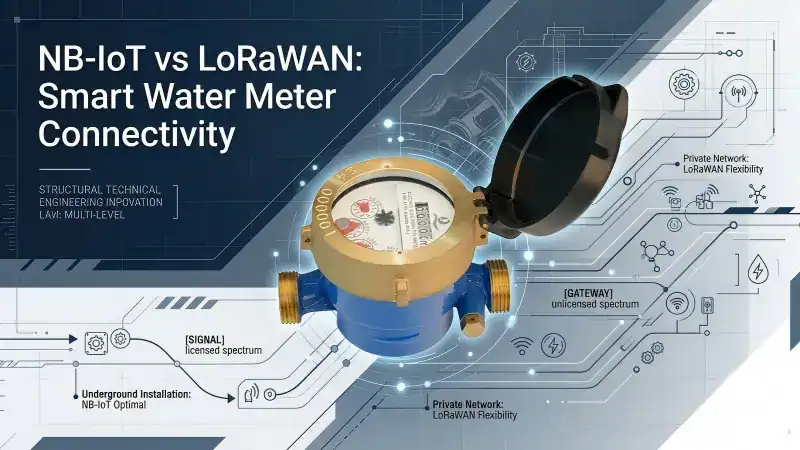
Upgrading your utility system? Choosing the right smart water meter connectivity is vital. In the debate of lorawan vs nb-iot, your choice impacts everything from deployment to total cost. Let’s explore these two powerful lpwa network technologies to find the perfect fit for your smart meter network.
LPWA Network Technologies: LoRaWAN and NB-IoT Basics
To understand your iot connectivity options, we must look at low-power wide-area (lpwan) networks. Both provide exceptional wireless solutions, easily outperforming older options like sigfox or bluetooth for stationary infrastructure.
The LoRaWAN Ecosystem
For a water meter project, LoRaWAN works well when you want to build a private network and manage local communication more directly. It is often used in wide-area sites where meter readings are sent at set intervals rather than continuously.
- Suitable for rural areas, campuses, farms, and industrial parks
- Uses gateways to connect multiple smart water meters across a local area
- Helps reduce dependence on mobile operators
- Fits water meter deployment with infrequent data uploads and long battery life
- A practical choice when you want more control over network setup and coverage
The NB-IoT Standard
For a water meter network, NB-IoT is often the better fit when you need utility-grade coverage and easier large-scale deployment. It uses an existing cellular network, so you do not need to build gateway infrastructure yourself.
- Well suited for urban utility projects and large city deployments
- Strong for underground, indoor, or basement water meter installation
- Supports reliable meter data transmission through mobile operators
- Reduces on-site setup because no separate gateway is required
- A strong option for smart meter projects needing stable connectivity and easier scaling
LoRaWAN vs NB-IoT: Key Utility Differences
Comparing lorawan and nb-iot reveals distinct advantages. You must evaluate data packets, power consumption, and environmental factors before you deploy. An nb-iot water setup generally provides lower latency and higher bandwidth.
On the other hand, a lora sensor offers incredible cost-effectiveness for infrequent data transmissions. It excels in low-power environments, ensuring extended energy consumption efficiency.
| Feature | NB-IoT | LoRaWAN |
| Network Type | Licensed spectrum | Unlicensed spectrum |
| Deep Indoor Penetration | Excellent | Good |
| Battery Life | 10+ years | 10-15+ years |
| Data Transmission | Real-time, higher payload | Infrequent, smaller payload |
TCO, Battery Life, and Cellular Deployment Factors
Calculating the tco (total cost of ownership) involves evaluating hardware, sim or esim authentication, and maintenance. If you want to optimize your system, consider these factors:
- Deployment: LoRa requires on-site gateway installations. NB-IoT is essentially plug-and-play via cellular connections.
- Battery Life: Both offer great longevity, but LoRa slightly edges out in overall battery life for simple sensors.
- Penetration: NB-IoT offers superior deep indoor penetration. This makes it perfect for a basement water meter setup.
NB-IoT vs LoRaWAN: Which Water Meter Should You Choose?
If you are choosing a water meter technology for a real project, the decision usually comes down to environment, network ownership, and data needs.
|
Your priority
|
Better choice
|
Why
|
|
Dense city deployment
|
NB-IoT
|
Uses existing cellular infrastructure and scales easily
|
|
Underground or basement meters
|
NB-IoT
|
Better deep indoor penetration in many utility scenarios
|
|
Rural or remote areas
|
LoRaWAN
|
Works well with private gateway deployment
|
|
Lowest ongoing operator dependency
|
LoRaWAN
|
You control the network instead of relying fully on a carrier
|
|
Faster utility rollout
|
NB-IoT
|
Less on-site network setup is usually needed
|
|
Long battery life for infrequent uploads
|
LoRaWAN
|
Very efficient for low-power meter communication
|
A simple way to decide is this:
- Choose NB-IoT if you want utility-grade cellular connectivity, easier mass deployment, and strong performance in urban or underground environments.
- Choose LoRaWAN if you want a private network, lower operator dependence, and good cost-effectiveness across a defined local area.
How DEAZESU Can Help
If you are comparing NB-IoT and LoRaWAN for a water meter project, DEAZESU can support both options. That gives you more flexibility to match the right connectivity solution to your installation environment, data frequency, and deployment scale.
Whether you need smart water meters for urban utility networks, residential buildings, campuses, or remote sites, DEAZESU can help you evaluate the most practical setup for your project. You can explore our AMR water meters here. If you need support selecting the right model or want to discuss your project, please contact us.
FAQs about NB-IoT vs LoRaWAN Water Meters
Which has better deep indoor penetration?
An nb-iot meter typically performs better in challenging environments. The licensed cellular power pushes through walls easily, making it ideal for deep indoor locations.
Do I need a gateway for both?
No. LoRaWAN requires a gateway to function. NB-IoT connects directly to a cellular network base station, skipping the gateway entirely.
Can both systems provide real-time data?
While both transmit data securely, NB-IoT is vastly superior for real-time, high-density traffic monitoring and updates.