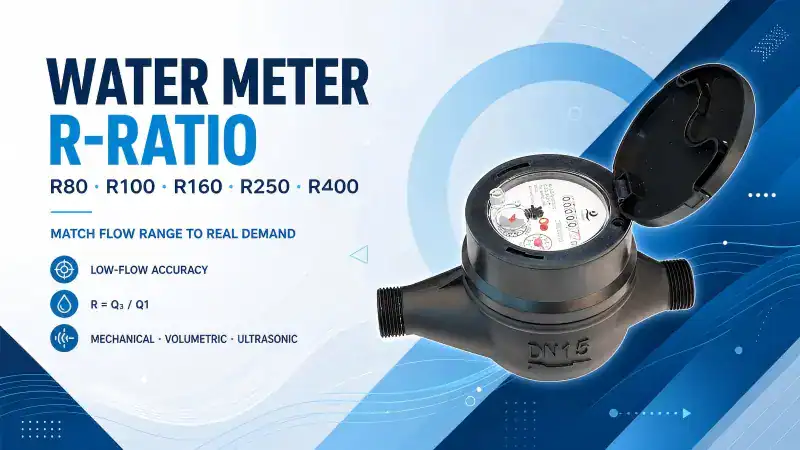
R80, R100, R160, R250 or R400? The number tells you how wide a water meter’s certified flow range is, but it does not tell you which meter will perform best in every project. Here is how to read the ratio and match it to real demand.
How Water Meter Flow Rates Define the R-Ratio
Under the terminology used in ISO 4064 and GB/T 778, four reference flow rates describe a meter’s metrological operating range. They let a utility compare products on a common basis instead of relying on vague claims about sensitivity or precision.
- Q1, minimum flow rate: the lowest flow at which the water meter must operate within its maximum permissible error.
- Q2, transitional flow rate: the boundary between the lower and upper error zones.
- Q3, permanent flow rate: the highest flow at which the meter operates within its rated conditions and permissible error.
- Q4, overload or maximum flow rate: the highest short-duration rate allowed while metrological performance is retained afterward.
The calculation is simple: R = Q3 / Q1. Rearranged, Q1 = Q3 / R. If two meters have the same Q3, a higher R means a lower specified Q1 and therefore a wider measurement range.
For example, with Q3 at 2.5 m³/h and R160, Q1 is 0.015625 m³/h, or 15.625 L/h. The label should be read as a range parameter, not as a blanket percentage for meter accuracy across every flow and installation condition.
R80 vs R100 vs R160 vs R250 vs R400 Flow Rates
The table holds the permanent flow rate constant at 2.5 m³/h so you can see the impact of R alone. It uses Q1 = Q3 / R. Actual datasheets may offer other Q3 values, orientations and performance classes, so always verify the selected model.
| R value | Q3 example | Calculated Q1 | Practical interpretation |
| R80 | 2.5 m³/h | 31.25 L/h | Basic low-flow reach where demand rarely drops to a trickle |
| R100 | 2.5 m³/h | 25 L/h | A modest step below R80 for general consumption profiles |
| R160 | 2.5 m³/h | 15.625 L/h | Broader low-flow coverage for residential and utility metering |
| R250 | 2.5 m³/h | 10 L/h | High sensitivity when small, legitimate use matters |
| R400 | 2.5 m³/h | 6.25 L/h | Very wide flow range for measuring low water usage |
Moving from R80 to R400 reduces the stated Q1 by 80%. That can improve revenue capture when consumption is frequently below the older meter’s measuring range. It may also support non-revenue water analysis by making continuous low-flow patterns more visible.
However, R is not the starting flow at which a pointer first moves, and it does not prove that every leak will be measured accurately. Leak detection also depends on event duration, installation, data resolution and whether readings reach a data logger or analytics platform.
Why a Higher R Is Not Always the Best Water Meter
A higher R only has operational value when the site actually spends meaningful time at low flow. Oversized pipework, intermittent supply, irrigation peaks and industrial batches create very different demand profiles. Analyze interval data or conduct a flow survey before choosing the range of the water meter.
Also check the complete specification rather than optimizing one number:
- Peak demand: Q3 and Q4 must still accommodate normal and short maximum flow without inappropriate sizing.
- Installation: orientation, upstream disturbance, available straight pipe and flow-profile sensitivity can affect field results.
- Water conditions: suspended material, scale, air and water quality can influence different measuring technologies differently.
- System needs: remote monitoring, reverse-flow records, alarms and communications may matter more than a small R increase.
- Lifecycle cost: purchase price, power, maintenance, verification and replacement should be assessed together.
In short, do not pay for R400 simply because it is the largest number. If nearly all billable flow stays well above an R100 meter’s Q1, the extra low-flow capability may have little impact. Correct sizing, installation and reliability can deliver more value.
Choosing Mechanical, Volumetric or Ultrasonic Flow Meters
Velocity-type mechanical meters, including single-jet and multi-jet designs, are familiar and practical for many residential or commercial networks. Start with an appropriate Q3, then choose R80, R100 or R160 when the expected profile supports it. Review DEAZESU’s mechanical water meter range to compare configurations.
Volumetric meters are positive-displacement devices. Their measuring principle can suit domestic applications where low and intermittent consumption is important. R160 or R250 may be useful targets, but water quality, pressure loss, installation space and local approval requirements still determine whether the design is suitable.
Ultrasonic meters have no moving measuring parts and can offer wide R values such as R250 or R400. They are strong candidates when low-flow visibility, remote reading or detailed monitoring supports water management goals. Compare the available ultrasonic water meters by Q3, R, communication option and environmental rating.
For a sound selection, first determine peak and typical flow, then estimate the lowest sustained billable flow. Confirm Q1, Q3, Q4, meter accuracy class, mounting position and pressure-loss class on the exact datasheet. Finally, assess communications and maintenance requirements across the expected service life.
Looking for a Reliable Water Meter Manufacturer?
DEAZESU is a professional water meter manufacturer with over 20 years of experience. We supply mechanical, AMR, ultrasonic, and electromagnetic water meters for global projects, and support remote reading solutions with NB-IoT, LoRa, and 4G technologies .
Whether you are sourcing for residential, commercial, or municipal water projects, DEAZESU is ready to help. You can explore more on our products page or contact us to discuss your project and request a quote .
FAQs about water meter R-ratio
Does R400 mean a water meter is five times more accurate than R80?
No. At the same Q3, R400 has one-fifth the Q1 of R80, so its specified range extends lower. The number does not mean every reading has five times less error. Accuracy limits, flow zone, installation and operating conditions still apply.
Can I compare R values without checking Q3?
No. R is a ratio, so you need Q3 to calculate the actual minimum flow rate. An R250 meter with a larger Q3 can have a higher Q1 than a smaller R160 meter. Compare Q1 in L/h or m³/h, not just the label.
Which R-ratio helps detect small leaks?
R250 or R400 can improve low-flow measurement when Q3 is correctly sized, making small continuous use easier to observe. Detection still requires useful reading intervals and a process that can distinguish a leak from legitimate consumption.
How should a utility select the final meter?
Use measured demand, required approvals, installation conditions and total cost. Then match the technology and R value to the project. To confirm a model’s Q1, Q3 and mounting requirements, contact DEAZESU for a water meter recommendation.