ISO 4064 is more than an accuracy label. It connects meter performance, testing, reports, construction, and installation—giving you a practical framework for comparing offers and checking compliance.
- Part 1 tells you what performance the meter must achieve.
- Parts 2 and 3 tell you how that performance is tested and documented.
- Parts 4 and 5 cover physical requirements and correct installation.
What ISO 4064 Covers
Published by the International Organization for Standardization, ISO 4064 applies to water meters for cold potable water and hot water flowing through a fully charged, closed conduit.
The standard covers traditional mechanical meters, electronic instruments, and meters based on ultrasonic or electromagnetic technology. It also addresses ancillary electronic devices where applicable.
The current suite combines ISO 4064 Parts 1–4 from the 2024 edition with ISO 4064-5:2025. Always state the exact part and edition in your specification.
ISO 4064 Parts at a Glance
Use the five parts together. Reading only Part 1 leaves testing, reporting, physical construction, and installation requirements unchecked.
| Part | Question it answers | Buyer action |
| ISO 4064-1 | What must the meter achieve? | Compare flow ratings, accuracy, marking, and operating limits |
| ISO 4064-2 | How must it be tested? | Check test methods, conditions, equipment, and acceptance criteria |
| ISO 4064-3 | How must results be recorded? | Request a complete, traceable report for the offered model |
| ISO 4064-4 | Does the physical meter suit the system? | Check dimensions, connections, pressure, temperature, and pressure loss |
| ISO 4064-5:2025 | How should it be selected and installed? | Verify fittings, orientation, site conditions, and commissioning |
Part 1: Meter Performance Requirements
Part 1 defines the rated measurement range. Start with three values:
- Q1: the minimum flow rate within the approved range.
- Q3: the permanent flow rate for continuous operation.
- R-ratio: Q3 ÷ Q1, indicating low-flow sensitivity.
A larger R-value extends the approved range toward lower flow, but it does not automatically improve every other parameter. Compare Q1, Q3, accuracy class, temperature class, and approved orientation together.
Part 1 also defines accuracy classes and maximum permissible error by flow zone. Other requirements cover operating conditions, durability, materials, electronic functions, and mandatory marking.
These requirements apply across measurement principles. A mechanical meter and an ultrasonic meter can both conform, but their technology, power needs, communication features, and field behavior remain different.
Parts 2–4: Testing, Reports, and Construction
- Part 2—Testing: defines equipment, conditions, test procedures, type evaluation, and initial verification.
- Part 3—Reporting: links each requirement to its method, conditions, result, and acceptance decision.
- Part 4—Construction: covers pressure loss, dimensions, connections, pressure, temperature, and other non-metrological characteristics.
Together, these parts prevent a vague “tested to ISO 4064” claim. You need evidence showing which part, edition, test method, sample, orientation, and acceptance requirement were used.
Part 5: Installation and Regional Standards
Part 5 covers meter selection, associated fittings, installation, special conditions, and first operation after installation or repair. Correct placement helps the instrument deliver reliable measurement and readable results.
Before installation, check:
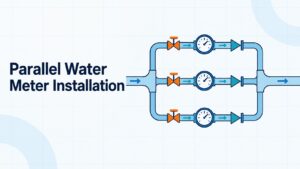
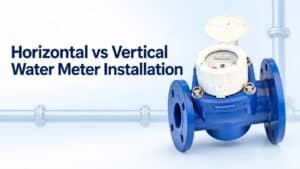
- Pipe arrangement, flow direction, and approved orientation.
- Accessibility, air risk, water quality, pressure, and temperature.
- Required upstream and downstream straight-pipe length.
A compliant product can still perform poorly when the installation does not match its approved conditions.
ISO 4064 was harmonized closely with OIML R 49. The 2014 revision became a “dual-logo” publication with matching technical content; the current 2024 documents reference OIML R 49-1 and related parts.
European projects may also cite EN 14154 or EN ISO 4064, while national standards and legal-metrology regulation can add mandatory conditions. Confirm the rules in the destination market rather than assuming one certificate fits every region.
Buyer Checklist: Price and Size Are Not Enough
Price and nominal diameter do not show measurement range, low-flow performance, pressure loss, or legal acceptance. Two same-calibre water meters can have different Q3, R-ratio, accuracy, communication, and installation ratings.
First, verify the supplier:
- Company identity, manufacturing address, and quality-management certificate.
- Type-approval or conformity certificate with model and edition clearly identified.
Then, verify the offered meter:
- Complete datasheet showing Q1, Q3, R-ratio, accuracy class, temperature, pressure, and orientation.
- ISO 4064-2 test reports using the ISO 4064-3 report structure.
- Pressure-loss, durability, environmental, and electronic test results where applicable.
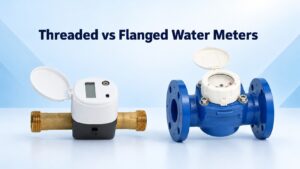
- Drawings showing body length, thread or flange dimensions, and installation interfaces.
- Permanent marking photos matching the datasheet and certificate.
- Calibration or initial-verification records for supplied units when contractually required.
Check that names, model codes, sizes, firmware or communication variants, and ratings remain consistent across every file. A certificate for a product family does not automatically cover every offered configuration.
Compare DEAZESU water meter products by measurement principle, flow range, communication method, and application before requesting a final technical submission.
FAQs about ISO 4064 Water Meters
Does ISO 4064 certification prove installation compliance?
No. Product conformity and installation are connected but separate. Check the approved orientation, fittings, straight-pipe requirement, operating conditions, and local regulation for the actual site.
Is a higher R-ratio always better?
It indicates a wider rated range toward low flow. You must still evaluate Q3, accuracy classes, pressure loss, water conditions, durability, communication needs, and lifecycle cost.
Can one report cover mechanical and electronic variants?
Only when the certificate and report scope explicitly include those configurations. Different sensing principles, electronics, power supplies, or software may require separate evidence.
Which ISO 4064 edition should a 2026 tender cite?
Cite Parts 1–4:2024 and Part 5:2025 unless binding national or regional standards require another edition. Write each part explicitly to prevent ambiguity.
Looking for a Reliable Water Meter Manufacturer?
DEAZESU offers mechanical, AMR, ultrasonic, and electromagnetic metering options for varied project requirements. Send DEAZESU your specification to discuss model selection and the supporting technical documents needed for your tender.