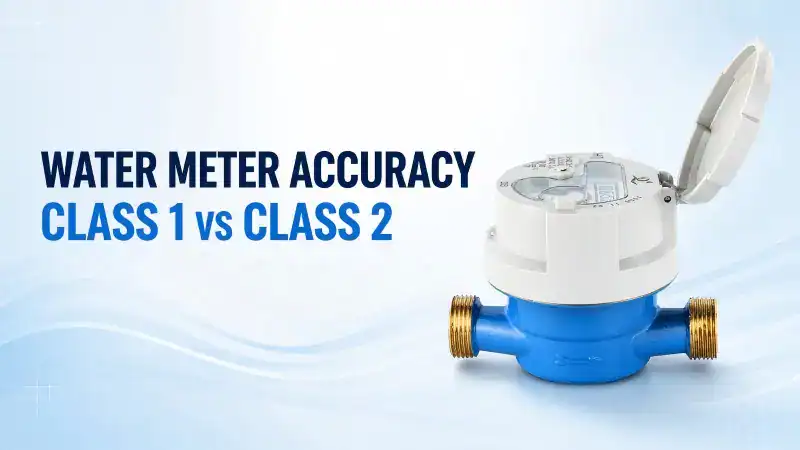
A water meter accuracy class tells you how closely a meter must measure actual water volume. Understanding the limits helps you compare specifications, readings, and applications without mistaking a tighter class for automatically better performance.
- Class 1: tighter limits for demanding measurement applications.
- Class 2: widely used where standard metering performance is sufficient.
- Key point: class, flow range, temperature, and installation must be evaluated together.
What Water Meter Accuracy Means
Water meter accuracy describes the relationship between the indicated volume and the reference volume that actually passes through the meter. It is normally expressed as relative error:
Relative error (%) = (indicated volume − reference volume) ÷ reference volume × 100
What MPE means: The accuracy class sets the maximum permissible error under defined flow and temperature conditions. It is a compliance limit, not the expected error of every reading.
Reading the result: A positive error means the register reads high; a negative error means it reads low. Controlled testing establishes the actual error curve.
Standards for Meter Accuracy Classification
ISO 4064-1:2024 defines current metrological requirements for cold potable and hot water meters. The closely aligned OIML R 49 framework classifies meter accuracy as Class 1 or Class 2.
These standards cover mechanical, electrical, and electronic measurement principles. Remote reading or monitoring does not give a smart water meter a different accuracy classification.
The American Water Works Association uses technology-specific AWWA standards and test flow rates. Those requirements do not use the same Class 1 and Class 2 labels, so evaluate them independently when an American specification governs your application.
Class 1 vs Class 2 Maximum Permissible Error
Quick comparison: Class 1 has tighter limits in both zones. At 30°C or below, its upper-zone limit is half the Class 2 limit.
| Accuracy class | Lower zone: Q1 ≤ Q < Q2 | Upper zone: Q2 ≤ Q ≤ Q4, 0.1–30°C | Upper zone: above 30°C |
| Class 1 | ±3% | ±1% | ±2% |
| Class 2 | ±5% | ±2% | ±3% |
Example: If 100 m³ passes through a cold-water meter in the upper zone, the boundaries are ±1 m³ for Class 1 and ±2 m³ for Class 2.
This comparison describes allowable error, not guaranteed savings. Billing impact also depends on water consumption, tariff, flow profile, installation, service condition, and whether errors consistently occur in one direction.
How Lower and Upper Flow Zones Work
A single error limit does not cover every flow rate. Q2 divides the rated range into lower and upper zones, each with its own measurement accuracy requirement.
| Flow value | Meaning | Why it matters |
| Q1 | Minimum flow rate within the rated range | Defines the lowest flow with a stated error limit |
| Q2 | Transitional flow rate | Separates the lower and upper error zones |
| Q3 | Permanent flow rate | Defines the highest rate for continuous operation |
| Q4 | Overload flow rate | Defines the maximum short-duration rate |
- Lower zone: Q1 ≤ Q < Q2.
- Upper zone: Q2 ≤ Q ≤ Q4.
- At Q2: use the tighter upper-zone limit.
Do not confuse accuracy class with dynamic range. The ratio R = Q3 ÷ Q1 shows how far the rated range extends toward low flow. A higher R can improve low-flow coverage without changing the meter accuracy class.
The chart above illustrates a typical Class 2 error curve. The blue lines show the maximum permissible error limits: ±5% in the lower zone and ±2% in the upper zone.
The red line represents a typical measured error curve. It must remain within the applicable limits from Q1 through Q4. Actual curves vary by meter model, calibration, installation, and operating condition.
How Temperature Class Affects Error Limits
Temperature class identifies the water temperature range for which a meter is approved. Common classifications include T30, T50, T70, T90, T130, and T180, plus defined hot-water ranges.
Above 30°C: Only the upper-zone MPE changes. Class 1 moves from ±1% to ±2%, while Class 2 moves from ±2% to ±3%.
Lower zone: The limits remain ±3% and ±5%, respectively. A wider temperature rating does not preserve the cold-water limit across the entire range.
Select the rating for actual service conditions. A T30 meter covers 0.1–30°C and should not be specified for hotter water merely because its room-temperature result looks precise.
Old Class A, B, C, and D Water Meters
ISO 4064:1993 used Classes A–D. These typical Qmin and Qt values show how their measurement ranges differed.
| Old class | Qmin | Qt | Example at Qn = 1.5 m³/h |
| Class A | 4% of Qn | 10% of Qn | Qmin 60 L/h; Qt 150 L/h |
| Class B | 2% of Qn | 8% of Qn | Qmin 30 L/h; Qt 120 L/h |
| Class C | 1% of Qn | 1.5% of Qn | Qmin 15 L/h; Qt 22.5 L/h |
| Class D | 0.75% of Qn | 1.15% of Qn | Qmin 11.25 L/h; Qt 17.25 L/h |
Lower Qmin and Qt values extended the approved range toward smaller flow rates, making Class D the widest.
Across these old classes, the typical MPE was ±5% from Qmin to below Qt and ±2% from Qt to Qmax. The class changed where those zones began.
The classes did not simply represent four different error percentages. Therefore, they are not direct equivalents of today’s Class 1 and Class 2 system.
Avoid automatically converting Class B to Class 2 or Class C to Class 1. For a 2026 specification, cite the governing standard, required flow values, temperature class, and approval instead of relying on a legacy label.
The photo below shows a water meter certified as Class 2 under the current standard. Its dial also carries the legacy Class C marking.
Typical Applications and Class Selection
Consider Class 1 when small percentage differences create meaningful financial or operational consequences, such as high-value billing or strict industrial water balances.
Consider Class 2 for residential or general commercial measurement when its limits meet the required cost-effectiveness and reliability targets.
- Estimate the water volume operating in each flow zone.
- Compare the MPE difference with tariff and billing exposure.
- Check Q1, Q3, R-ratio, calibre, and peak load.
- Confirm temperature, pressure, orientation, and water quality.
- Request type-approval evidence for the exact offered model.
High accuracy is valuable only when the whole installation supports it. Oversizing, air, sediment, disturbed flow, or unsuitable orientation can reduce practical reliability even when the meter carries the tighter class.
Different types of water meters may satisfy the same project differently. Compare DEAZESU mechanical, AMR, ultrasonic, and electromagnetic water meters by certified range and application before you select.
FAQs about Water Meter Accuracy Class
Is Class 1 always better than Class 2?
Class 1 has tighter MPE limits, but it is not always the better project choice. Required low-flow coverage, temperature, installation, approval, lifecycle cost, and actual usage also matter.
Does a higher R-ratio mean higher accuracy?
No. R describes measurement range, while accuracy class controls permissible error within that range. Evaluate both values because they answer different questions.
Does temperature change lower-zone accuracy?
No. Temperature above 30°C changes the upper-zone limits only. The lower zone remains ±3% for Class 1 and ±5% for Class 2.
What should a bidder provide as proof?
Request the type-approval certificate, complete flow and temperature ratings, approved installation orientation, relevant test reports, and a datasheet matching the exact model—not a general product-family brochure.
Looking for a Reliable Water Meter Manufacturer?
DEAZESU supplies mechanical and smart water meter options for varied flow, temperature, and communication requirements. Send your project conditions to DEAZESU for model selection and a specification review.