Standard measurement devices often fail to detect trickling fluids. To capture every drop, you need a specialized low flow rate water meter. This guide explores the top technologies to measure slow-moving liquid flow. Discover how the right device ensures precise data, prevents waste, and optimizes your commercial operations.
What is a Low Flow Rate Water Meter?
Every flow meter has a measurable range between its minimum flow and maximum flow. Within that range, the manufacturer states how accurately the meter can measure the fluid.
A useful concept is the turndown ratio, also called rangeability:
Turndown ratio = maximum flow ÷ minimum flow
For example, a meter with a maximum flow of 100 units and a 100:1 ratio may theoretically measure down to one unit. A larger ratio generally provides a wider operational range, but you should still check the actual accuracy limits at different flow rates.
Without the proper meter, you risk accumulating unrecorded fluid usage. Over time, these minor daily inaccuracies create massive financial losses. Choosing the proper instrument helps you maintain a truly accurate and profitable pipeline.
Here are the defining traits of these specialized meters:
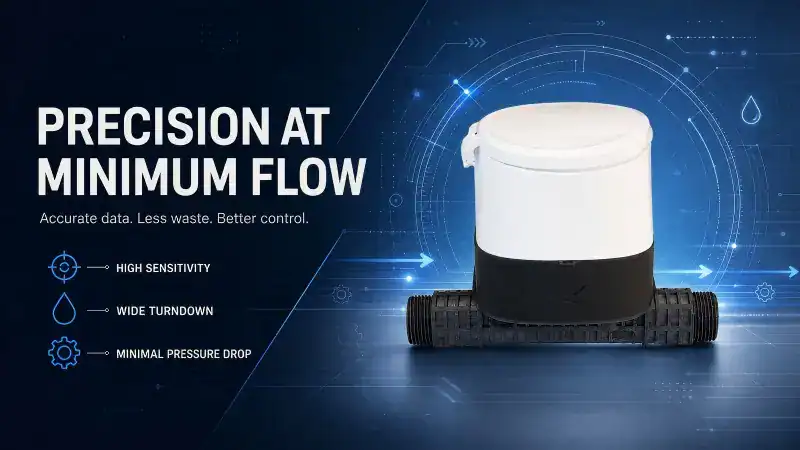
- High sensitivity sensors: Designed to detect microscopic fluid movement.
- Minimal pressure drop: They do not restrict the natural flow of the pipeline.
- Broad turndown ratio: Capable of reading both standard and exceptionally low flow rates.
Why High Accuracy Matters in Every Fluid Application
You might wonder why absolute precision is vital for small volumes. In commercial settings, even a tiny error in a daily reading adds up. Accurate measurement ensures quality control and prevents costly resource waste.
Many specialized industrial processes cannot tolerate fluctuations in fluid delivery. A highly accurate flow meter guarantees your system performs exactly as designed. It acts as the ultimate safeguard for your operational integrity.
Below is a breakdown of why different sectors require precise monitoring:
| Industry Application | Consequence of Poor Accuracy | Why Precision is Required |
| Water Treatment | Unsafe municipal drinking water. | Requires exact chemical dosing to purify water safely. |
| Chemical Manufacturing | Ruined product batches and safety hazards. | Needs precise fluid amounts to maintain stable reactions. |
| Commercial Agriculture | Crop failure and wasted water resources. | Drip irrigation demands accurate, slow-release watering. |
| Facility Management | High utility bills and structural water damage. | Early leak detection relies on sensing minimal water flow. |
Implementing a reliable meter makes your overall facility management easier. You gain total confidence that your data reflects the real-world conditions of your pipes.
Best Flow Meter Types to Measure Minimum Flow
Not all metering devices are built the same way. Choosing the ideal type depends on your fluid characteristics, pressure limits, and operational needs. Let’s look at the primary technologies used to measure slow-moving liquids.
Ultrasonic Technology for Low-Flow
An ultrasonic flow meter is an excellent choice for low-flow scenarios. These advanced devices use high-frequency sound waves to determine the velocity of the liquid. Because they have no internal moving parts, they experience far less wear over time.
They are incredibly precise and maintain their performance even when measuring minimum flow. Furthermore, they do not cause restricted pressure drops within your pipeline. You can browse modern, high-tech options directly on our products page.
Key benefits of ultrasonic technology include:
- Exceptional accuracy at very low flow rates.
- Zero pipeline obstruction.
- Long lifespan with minimal maintenance required.
Magnetic and Mechanical Options
Mechanical devices use a physical rotating element, like a paddlewheel, to measure volume. They are reliable and cost-effective for standard use. However, they struggle if the liquid flow is too slow to physically push the internal components.
A magnetic flow meter works beautifully for highly conductive fluids. It uses a strong electromagnetic field to detect movement. This provides an impressive range and allows it to operate smoothly without obstructing the pipe.
Comparing High vs. Low Flow Rates
Understanding the difference between high and low flow requirements is essential. Using a meter designed for a high maximum flow in a low-volume setting is a common engineering mistake. It consistently results in poor data and missed billing opportunities.
High-flow meters handle massive volumes and intense pressure. However, their internal sensors are often not sensitive enough to detect a gentle fluid trickle. They prioritize raw durability over micro-precision.
Conversely, a low flow rate meter uses hyper-sensitive digital sensors to capture tiny movements. Matching the measurement device to your actual daily flow rates is the secret to an efficient setup.
| Feature | High Flow Meters | Low Flow Meters |
| Primary Use | Main utility lines, industrial cooling. | Chemical injection, leak detection, dosing. |
| Sensitivity | Low sensitivity at minimal velocities. | Extremely high sensitivity to slow movement. |
| Design Focus | Handling high pressure and massive volume. | Capturing micro-movements accurately. |
| Technology | Often mechanical or large-scale turbine. | Ultrasonic, magnetic, or specialized positive displacement. |
The Advantage of Upgrading Your Flow Meter System
Installing the proper metering technology fundamentally improves your daily operations. You gain uncompromising control over your entire fluid network. By closely monitoring these metrics, facilities can identify pipeline inefficiencies instantly.
You stop guessing about your water usage and start making data-driven decisions. This directly benefits your bottom line. Read more industry tips and best practices on our blog.
Upgrading your system provides several clear operational advantages:
- Direct Cost Savings: Prevents unbilled water usage and reduces waste.
- Proactive Monitoring: Delivers real-time data for immediate system analysis.
- Lower Maintenance: Solid-state meters require far fewer manual repairs.
- Process Consistency: Ensures chemical mixtures and dosages remain perfectly balanced.
Understanding both your peak demands and your absolute minimum requirements helps you improve overall efficiency. This proactive approach leads to better resource management.
FAQs about Low Flow Water Meters
How do you measure low flow rates accurately?
To achieve a truly accurate reading, you must install a flow meter calibrated for very low velocities. Ultrasonic and electromagnetic water flow meters are usually the best choices. They reliably detect minimal movement without relying on physical force.
What industry applications benefit from a low-flow system?
Many commercial sectors rely heavily on these specialized measurement devices. Common examples include pharmaceuticals, precise agriculture, and municipal water treatment plants. Any facility requiring strict chemical dosing or automated leak monitoring will benefit.
How do I maintain these types of meters?
Routine maintenance depends heavily on the specific technology type you install. To maintain accurate performance, devices with no moving parts require very little physical upkeep. Always follow the manufacturer’s operational guidelines to keep your system optimized.
Do water flow meters operate differently at a lower pressure?
Yes, pressure directly impacts how a meter performs. If the pressure drops too low, mechanical meters may fail to spin. Advanced digital meters are designed to measure velocity accurately regardless of pressure changes.
Can a standard water meter handle a low flow rate?
Generally, no. Standard high-capacity commercial meters have a minimum starting threshold. If the fluid moves slower than that threshold, the meter will simply not record the usage. This leads to permanently lost data.
Looking for a Reliable Water Meter Manufacturer?
DEAZESU is a professional water meter manufacturer with over 20 years of experience. We supply mechanical, AMR, ultrasonic, and electromagnetic water meters for global projects, and support remote reading solutions with NB-IoT, LoRa, and 4G technologies .
Whether you are sourcing for residential, commercial, or municipal water projects, DEAZESU is ready to help. You can explore more on our products page or contact us to discuss your project and request a quote.