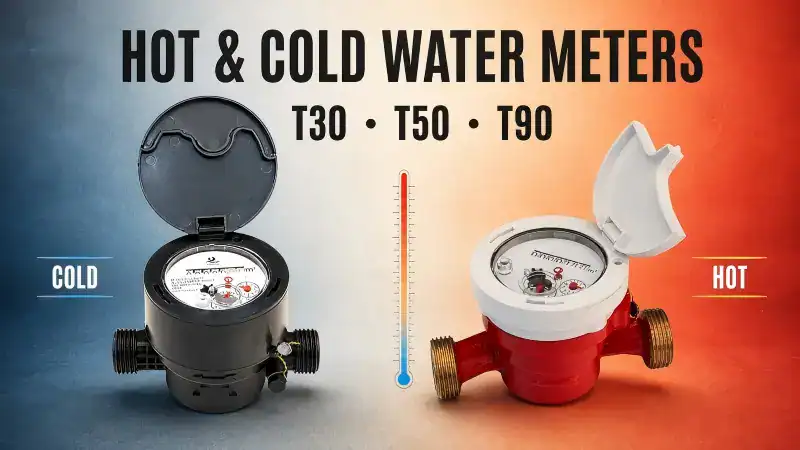
T30, T50, and T90 tell you the approved water temperature range—not simply whether a meter is “hot” or “cold.” Choose the wrong class, and measurement accuracy, seals, and service life may suffer.
What T30, T50, and T90 Mean for a Water Meter
Under ISO 4064 and OIML R 49, the temperature class defines the meter’s minimum and maximum admissible water temperature at the inlet.
| Temperature class | Rated water temperature | Fahrenheit range | Typical starting point |
| T30 | 0.1°C to 30°C | About 32.2°F to 86°F | Residential and commercial cold water |
| T50 | 0.1°C to 50°C | About 32.2°F to 122°F | Cold or moderately warm water with a higher temperature margin |
| T90 | 0.1°C to 90°C | About 32.2°F to 194°F | Domestic hot water and selected industrial applications |
The “T” number is the maximum admissible temperature, or MAT. It is a continuous rated limit, not a recommended operating setpoint.
Other classes also exist, including T70, T130, and T180. Dual-limit markings such as T30/90 cover 30°C to 90°C rather than starting at 0.1°C.
Cold Water Meter vs Hot Water Meter
Both meter types measure water volume. The key difference is whether every relevant component can maintain its function and metrological performance at the declared temperature.
Hot water meters are not defined by appearance alone. Their declared class and approval must cover the operating conditions of the hot water application.
| Selection point | Cold water meter | Hot water meter |
| Common class | T30 or T50 | T70, T90, or a higher applicable class for hot water meters |
| Materials | Selected for pressure, potable-water compatibility, and corrosion resistance | Seals, plastics, register parts, and electronics must also resist sustained heat |
| Main risk | Freezing, debris, unsuitable installation, or unexpected warm water | Seal aging, scale, thermal cycling, and heat-related drift or damage |
| Typical application | Domestic mains, utility distribution, and cold process water | Apartment hot-water billing, hotels, laundries, and hot process lines |
Blue and red parts can help installers identify a meter, but color is not proof of temperature class. Verify the marking, approval certificate, datasheet, and test documentation.
How Temperature Affects Measurement Accuracy
Heat can change clearances, seal behavior, water properties, electronic response, and mechanical resistance. A suitable meter is designed and tested to keep the reading within its applicable error limit.
For an accuracy class 2 meter, the upper-zone maximum permissible error is ±2% from 0.1°C to 30°C and ±3% above 30°C. The lower-zone limit remains ±5%.
Therefore, a T90 marking does not promise the same error limit at every temperature. Temperature class and accuracy class answer different questions and should appear separately in your specification.
- Temperature class: Which inlet water temperatures can the meter withstand during rated operation?
- Accuracy class: What measurement error is allowed in the lower and upper flow zones?
- Flow ratings: At which flow rate does each error limit apply?
What the Short-Time Overload Test Proves
The current OIML R 49 requirements include an overload water temperature test for meters with MAT of at least 50°C.
The meter is exposed to flowing water at MAT + 10°C, within the specified tolerance, for one hour after temperature stability is reached.
| Meter class | Rated maximum | Overload test temperature | Test duration |
| T30 | 30°C | Not covered by this MAT ≥ 50°C test requirement | Not applicable |
| T50 | 50°C | 60°C | 1 hour |
| T90 | 90°C | 100°C | 1 hour |
After recovery, the meter is checked at Q2. Volume totalization and declared functions must remain unaffected, and the measurement error must stay within the applicable limit.
This is a survival-and-performance check, not permission to operate continuously at 60°C on T50 or 100°C on T90. Continuous use must remain within the rated range.
Which Temperature Class Fits Your Application?
Start with measured inlet temperature data, including seasonal peaks and normal process variation. Then add a justified margin without substituting guesswork for the project specification.
- Residential cold water: Choose T30 when the supply remains at or below 30°C. Consider T50 where warm climates, exposed tanks, or mixed-water risk can raise the temperature.
- Residential hot water: T90 is a practical choice when the distribution system can exceed 50°C. Confirm the actual maximum, approval scope, flow range, and billing regulation.
- Commercial buildings: Separate cold and hot branches. Do not use one class for every line unless its certificate and technical requirements cover each application.
- Industrial water: Match the class to continuous and peak process temperature. Also verify pressure, water chemistry, materials, flow rate, installation environment, and communication requirements.
For industrial temperatures above 90°C, select a suitable higher class instead of relying on the T90 overload test. The offered meter must be approved for the intended duty.
Buyer Checklist for Hot and Cold Water Meters
Send suppliers the same operating data so quotations remain comparable. Price and nominal size alone cannot confirm suitability.
- Required temperature class and actual minimum, normal, and maximum water temperature
- Meter accuracy class, Q1, Q2, Q3, Q4, and expected operating flow
- Nominal diameter, connection, pressure rating, orientation, and available straight pipe
- Potable-water, MID, or local regulatory requirement where applicable
- Approved materials for the water system, including seal and gasket specifications
- Type-approval certificate, datasheet, marking photo, and relevant temperature test report
- Pulse, M-Bus, LoRa, NB-IoT, or other monitoring requirement
Check that the certificate identifies the offered model and temperature class. A generic family brochure does not prove that a particular meter is T90 compliant.
FAQs about T30, T50, and T90 Water Meters
Can a T30 cold water meter measure hot water?
No. T30 is rated only up to 30°C. Using it above that limit can affect durability, structural integrity, and measurement reliability.
Is a T50 meter a hot water meter?
It can measure water continuously up to 50°C, but that may be insufficient for many domestic hot water systems. Select by actual maximum temperature, not the product label.
Can a T90 meter be used for cold water?
A T90 class covers 0.1°C to 90°C, subject to the approval and manufacturer’s conditions. However, it may add unnecessary cost where T30 fully meets the requirement.
Does T90 mean better measurement accuracy than T30?
No. T90 describes temperature capability. Measurement accuracy depends on the separate accuracy class, flow zone, test temperature, and applicable regulation.
What should I send when requesting a quotation?
Provide temperature, flow, pressure, pipe size, water quality, installation position, approval, and communication needs. Clear inputs help the supplier select the right type of meter.
Looking for a Reliable Water Meter Manufacturer?
DEAZESU supplies mechanical, smart, ultrasonic, and electromagnetic water meter options. Contact DEAZESU for a quotation with your temperature range and operating conditions so the proposed meter can be checked against your application.