A water meter is the device that tracks how much water enters your home, apartment, or commercial building. Utilities use it to measure total consumption and calculate your water bill.
Most water meters record usage in gallons or cubic feet, depending on your provider. The reading shows how much water has passed through the service line over time.
You can think of a water meter like a car odometer. As water flows through the pipe, the meter updates and records the total amount used across showers, sinks, laundry, and outdoor taps.
What a Water Meter Measures
| Item | What It Shows |
|---|---|
| Water volume | Total water entering the property |
| Usage trend | Whether consumption is stable or rising |
| Billing data | The amount used for utility charges |
| Low flow activity | Small water movement that may indicate a leak |
How to Read Your Meter and Understand a Reading
To read your meter, first find its location. It may be inside the home, such as in a basement or utility room, or outside near the curb under a meter lid.
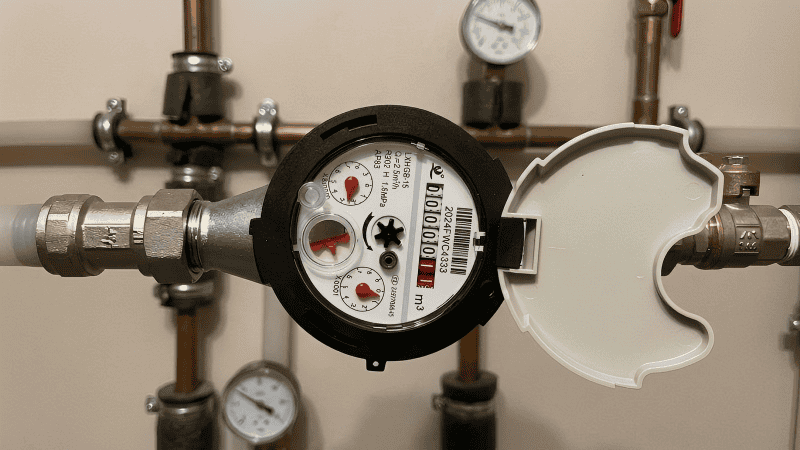
A water meter reading shows how much water your property has used. Analog meters usually display a row of numbers and small dials, while digital meters show the total more clearly on a screen.
The small dial or flow indicator can help detect water movement even when no fixtures are running. That makes it useful for spotting hidden leaks.
Quick Reading Tips
- Locate the meter inside or outside the property
- Check the display for total usage
- Look at the small dial for low-flow movement
- Compare readings over time to track water use
- Watch for movement when no water is being used
Different Types of Water Meters and Installation Basics
There are several types of water meters, and each works differently based on the property, pipe size, and flow needs. The most common options are analog, digital, and ultrasonic meters.
Choosing the right meter depends on the size of the service line, the building type, and how accurately the utility wants to track water flow.
Analog, Digital, and Ultrasonic Meters
| Meter Type | Main Feature | Best For |
|---|---|---|
| Analog | Uses moving parts and dial display | Older home systems |
| Digital | Clear screen and easier reading | Properties needing simple visibility |
| Ultrasonic | Uses sound waves, no moving parts | Long-term accuracy and low maintenance |
Key differences:
- Analog meters are common in older residential systems
- Digital meters are easier to read
- Ultrasonic meters are often more accurate over time
Installation Basics
A water meter must fit the service line correctly to work properly. Installers check the line diameter, property type, and meter location before installation.
A proper fit supports accurate readings, smooth flow, and easier maintenance later.
Installation factors include:
- Pipe size
- Property type
- Meter type
- Indoor or outdoor location
- Utility requirements
How a Water Meter Helps You Spot a Leak and Lower Your Bill
A water meter can help you detect leaks early. If all faucets and appliances are off but the meter keeps moving, water may be flowing somewhere it should not.
Even a small hidden leak can increase your bill over time. Regular meter checks help you catch unusual usage before it becomes expensive.
This is also useful for tenants. If you want to confirm whether your bill reflects actual use, ask your landlord where the meter is located or whether you can review the readings.
Signs Your Meter May Be Showing a Leak
- The meter moves when no water is being used
- Usage rises without a clear reason
- Bills suddenly increase
- Low-flow indicator continues to move
FAQ
What is a water meter used for?
A water meter is used to measure the amount of water entering your property so your provider can bill you fairly and monitor usage.
How do you know if a water meter shows a leak?
If no one is using water and the meter still shows movement or ongoing flow, that can signal a leak.
Are digital water meters better than analog meters?
Not always, but digital models are often easier to read, while analog meters are simple and widely used. The best meter depends on your home and budget.
Where is a water meter usually located?
You can usually locate a water meter near the curb, in a meter box, basement, garage, or utility area.
Do all homes have a water meter?
Not every older residence does, but most modern homes and many used in residential systems now rely on a water meter for accurate billing. Bottom line: your water meter is the tool that tracks usage, supports fair billing, and helps you catch problems early. Learn to check it once in a while, and you will understand your bill a lot better.
Looking for a Reliable Water Meter Manufacturer?
DEAZESU is a leading manufacturer with 20 years of expertise in high-precision water metering solutions, offering mechanical, ultrasonic, and IoT-enabled smart meters with NB-IoT, LoRa, and 4G technology. We provide certified products (CE, MID, ISO9001) and support custom OEM/ODM solutions for residential and industrial applications.
Contact us today! We’re here to help you find the right water meter solution for your business.