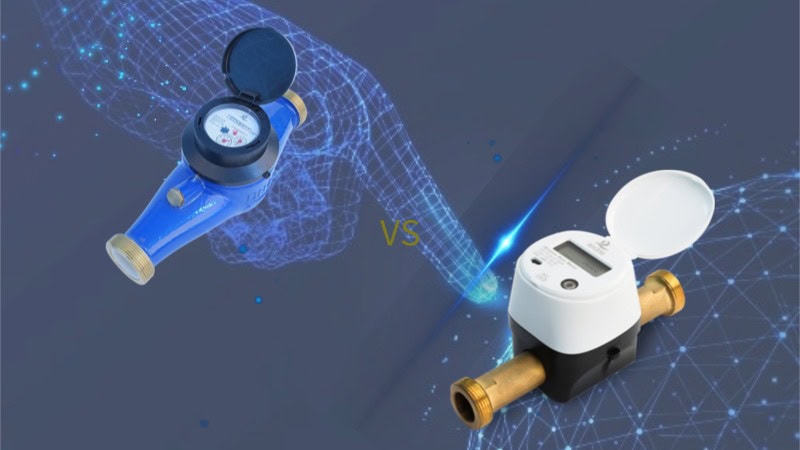
Water meters are essential tools for monitoring consumption, managing resources, and ensuring accurate billing. While mechanical meters have been the standard for over a century, ultrasonic water meters represent a modern, electronic alternative.
This article breaks down the key differences, advantages, and selection criteria to help you make an informed decision.
How They Work: Core Technologies Explained
Mechanical Water Meters
Mechanical meters operate using moving parts that are physically driven by the flow of water. The most common types are:
- Positive Displacement (PD) Meters:Use a piston or nutating disk that fills and empties with water, directly measuring volume. Common in residential settings.
- Velocity Meters:Measure the speed of water flow using a turbine or propeller, converting it into volume. Often used in larger service lines.
The movement of these internal components drives a mechanical register (like an odometer) that displays total consumption.
Ultrasonic Water Meters
Ultrasonic meters have no moving parts. Instead, they use ultrasonic sound waves to measure flow velocity. There are two primary methods:
- Transit-Time Difference:Two sensors send ultrasonic pulses both with and against the flow. The difference in transit time is directly proportional to the water’s velocity.
- Doppler Effect:Measures the frequency shift of ultrasonic waves reflected by particles or bubbles in the water (more common in wastewater or dirty water applications).
An electronic calculator converts velocity and pipe diameter into a volume measurement, displayed on a digital screen.
|
Feature |
Mechanical Meters |
Ultrasonic Meters |
|
Technology |
Moving parts (piston, turbine) |
Ultrasonic sensors, no moving parts |
|
Accuracy |
High at medium-high flow, lower at very low flow |
Excellent across a wide flow range, especially at low flow |
|
Longevity & Maintenance |
Prone to wear and tear; requires periodic maintenance |
Highly durable with minimal maintenance; sensitive to water quality issues |
|
Initial Cost |
Lower initial purchase price |
Higher initial investment |
|
Pressure Loss |
Can cause moderate to high head loss due to obstructions |
Negligible pressure drop (full-bore design) |
|
Data Capabilities |
Basic totalized volume only (unless paired with an encoder) |
Advanced: digital output, remote reading, leak detection, flow profiling, bidirectional measurement |
|
Installation Orientation |
Often sensitive to orientation (must be installed level/horizontally) |
Generally insensitive to installation position |
|
Susceptibility |
Wear from silt/debris; magnetic tampering |
Air bubbles or heavy particulate can disrupt readings |
Key Differences at a Glance
Advantages and Disadvantages
Mechanical Meters: The Tried-and-True
Advantages:
- Proven Reliability:Simple, well-understood technology with a long history.
- Lower Upfront Cost:Significantly cheaper to purchase initially.
- No Power Required:Operates purely on water flow (though electronic registers may need a battery).
- Effective for Clean Water:Performs reliably in standard municipal water supplies.
Disadvantages:
- Mechanical Wear:Parts degrade over time, leading to under-registration and revenue loss. Requires replacement.
- Limited Data:Provides only basic consumption data without additional components.
- Poor Low-Flow Sensitivity:Often fails to register very small leaks or drips.
- Pressure Drop:Internal components restrict flow, increasing system energy demand.
Ultrasonic Meters: The Modern Solution
Advantages:
- High Accuracy & Wide Range:Maintains precision across very low to very high flow rates (high turndown ratio).
- No Moving Parts:Eliminates mechanical wear, leading to a longer predictable lifespan and reduced maintenance.
- Advanced Metering Infrastructure (AMI) Ready:Native digital output enables easy integration with smart networks for automated meter reading, leak alerts, and consumption analytics.
- Near-Zero Pressure Loss:Full-pipe bore design improves system efficiency.
- Bidirectional Flow Measurement:Can measure flow in both directions, useful for specific applications.
Disadvantages:
- Higher Initial Cost:More expensive to purchase.
- Power Dependency:Requires a battery (often with a 10+ year life) or external power.
- Sensitive to Water Quality:Air bubbles or heavy sedimentation can cause reading errors. Best for clean water.
- Complexity:Requires technical expertise for diagnostics and servicing.
How to Choose the Right Water Meter
Selecting the right meter depends on your specific application, priorities, and budget. Consider the following questions:
1. What is the application?
- Residential/Small Commercial:Mechanical PD meters are cost-effective and sufficient for most standard homes. However, for high-value properties, leak detection benefits, or where low-flow accuracy is critical (e.g., conservation programs), ultrasonic is superior.
- Large Commercial/Industrial:Ultrasonic meters excel due to their wide flow range, lack of pressure loss, and advanced monitoring capabilities for complex water systems.
- Municipal Water Utilities:Increasingly adopting ultrasonic meters for their longevity, data capabilities, and reduced revenue loss from meter degradation. Mechanical meters may still be used where budgets are tight and water quality is ideal.
2. What is your primary goal?
- Minimize Upfront Cost:Choose mechanical.
- Minimize Lifetime Cost & Revenue Loss:Choose ultrasonic. The higher initial cost is often offset by longer life, less maintenance, and sustained accuracy.
- Enable Smart Water Networks:Choose ultrasonic for seamless integration with AMI systems.
- Maximize Low-Flow Leak Detection:Choose ultrasonic.
3. What are the water conditions?
- Clean, Particle-Free Water:Both types are viable.
- Air Bubbles or Particulate Present:A mechanical meter may be more robust, or a Doppler-type ultrasonic meter should be considered for dirty water.
- Abrasive or Corrosive Water:The wear-free nature of ultrasonic meters gives them a clear advantage.
4. What is the required data output?
- Basic Total Consumption Reading:A standard mechanical register is adequate.
- Remote/Billable Data, Alerts, Hourly Consumption:You need an ultrasonic meter or a mechanical meter with an added pulse transmitter/encoder.
The Future Trend
The water industry is steadily moving toward digitalization and smart infrastructure. Ultrasonic meters are at the forefront of this trend, offering utilities and building managers unprecedented insights into water use patterns, system pressure, and loss detection. While mechanical meters will remain in service for years to come due to their vast installed base and simplicity, new installations—especially where data, accuracy, and efficiency are priorities—are increasingly favoring ultrasonic technology.
Conclusion
In conclusion, there is no one-size-fits-all answer. Mechanical water meters are a robust, economical choice for straightforward applications with clean water and tight budget constraints. Ultrasonic water meters represent a forward-looking investment that pays dividends in accuracy, data intelligence, and operational savings over the long term. Evaluate your specific needs to make the most sustainable and economical decision for your water management strategy.