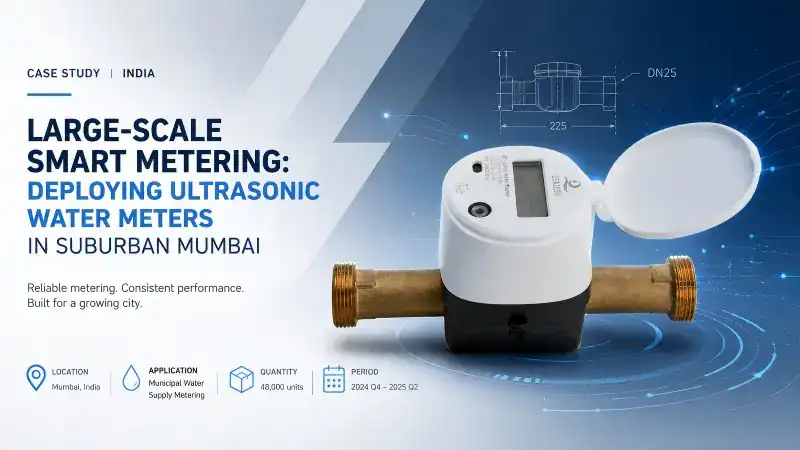
A case study on large-scale deployment of ultrasonic brass water meters for improved metering stability and installation consistency in a fast-growing urban water network in India.
At a Glance
- Project Location: Mumbai, India (suburban municipal wards)
- Client Type: A Mumbai-based trading company supplying municipal infrastructure projects
- Product Supplied: Ultrasonic Water Meter DN25–DN40 (brass body)
- Total Quantity: 48,000 units
- Project Period: 2024 Q4 – 2025 Q2
- Application: Municipal water supply metering for medium-to-high consumption users
- Key Requirement: Stable billing measurement, scalable deployment, long-term operational reliability

Background
Mumbai’s suburban districts continue to experience steady growth in residential and commercial water demand. Distribution networks in these areas often require metering systems that can maintain stable performance under variable flow conditions.
A local trading company engaged DEAZESU to support a municipal metering rollout targeting improved consumption visibility and operational consistency across multiple wards.
The project focused on DN25–DN40 ultrasonic meters designed for brass-body durability and long-term deployment stability.
Learn more about our company background here: DEAZESU Homepage
The Challenge
The project presented a combination of technical and operational constraints commonly seen in large municipal deployments:
- Mixed installation environments across residential and semi-commercial zones
- Variations in water flow profiles during peak and off-peak hours
- Need for consistent meter behavior across thousands of units
- Pressure to ensure installation efficiency across multiple contractors
- Concerns about long-term reading stability for billing reconciliation
The trading company also needed assurance that meters could support large-volume deployment without increasing maintenance workload or calibration inconsistencies.
The Solution
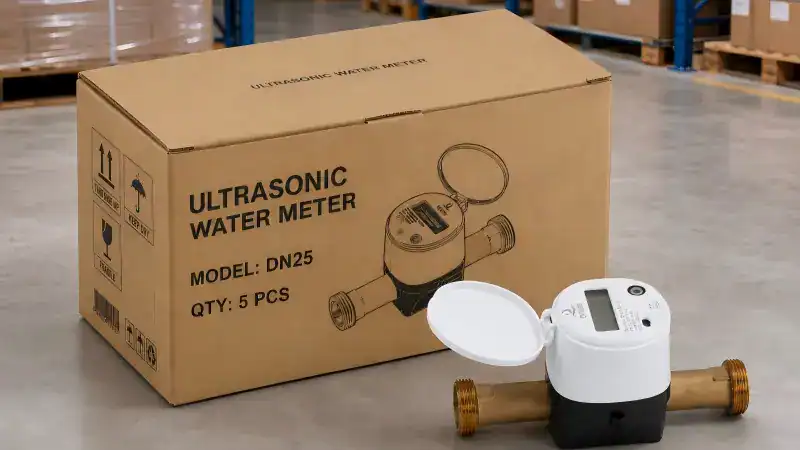
DEAZESU supplied Ultrasonic Water Meter DN25–DN40 brass body series, configured for stable low-flow sensitivity and broad dynamic measurement range.
Key technical characteristics aligned with project requirements:
| Parameter | Specification |
| Nominal Diameter | 25 mm (1″) |
| Length (L) | 225 mm |
| Flow Range (Q3/Q1) | 400 / 250 |
| Permanent Flow (Q3) | 6.3 m³/h |
| Overload Flow (Q4) | 7.875 m³/h |
| Minimum Flow (Q1) | 16.0–25.2 L/h |
| Maximum Pressure | MAP16 (16 bar) |
| Protection Rating | IP68 |
| Temperature Range | T30 / T50 / T70 |
| Battery Life | ≥ 10 years (Lithium battery) |
Product-to-Application Fit
The DN25 ultrasonic platform was selected due to its suitability for:
- Stable measurement under fluctuating municipal pressure
- Reduced mechanical wear compared with traditional meters
- Installation flexibility in confined residential pits
- Long lifecycle operation with minimal intervention
The brass body design further improved durability in variable water quality environments typical of urban distribution systems.
The Solution Implementation
The supply strategy emphasized batch consistency and installation readiness.
Key execution steps included:
- Pre-shipment calibration checks to maintain batch uniformity
- Standardized connection configuration (R1 / G 1 1/4 B threads)
- Packaging optimized for high-volume logistics handling
- Technical documentation support for field installers
The deployment approach helped reduce variability during installation across different subcontractor teams.
Technical coordination was supported via: DEAZESU Contact Page
Project Results
While the project is ongoing in terms of long-term lifecycle evaluation, early deployment feedback highlighted several practical improvements:
- More consistent installation outcomes across multiple wards
- Reduced need for post-installation adjustments
- Improved readability and remote verification compatibility in field conditions
- Smoother integration into municipal billing workflows
The overall deployment process demonstrated strong compatibility between product design and municipal infrastructure requirements.
From an operational perspective, the trading company reported improved coordination efficiency during phased deliveries, particularly in peak installation periods.
Customer Feedback
A representative from the trading company shared the following observation:
“The consistency across batches made installation planning much easier. Field teams were able to standardize procedures, which reduced uncertainty during rollout.”
This feedback reflects a key priority in municipal projects: minimizing variability at scale.
Conclusion
The Mumbai suburban deployment highlights the importance of combining measurement stability with scalable logistics in urban water infrastructure projects.
The Ultrasonic Water Meter DN25–DN40 series demonstrated strong adaptability to real-world installation conditions, particularly in environments requiring consistent billing and long-term operational reliability.
For similar municipal or commercial metering projects, DEAZESU continues to focus on:
- Stable ultrasonic measurement architecture
- Durable brass construction for urban environments
- Long-life battery design supporting multi-year deployment cycles
Explore more technical articles and application insights here: DEAZESU Blog