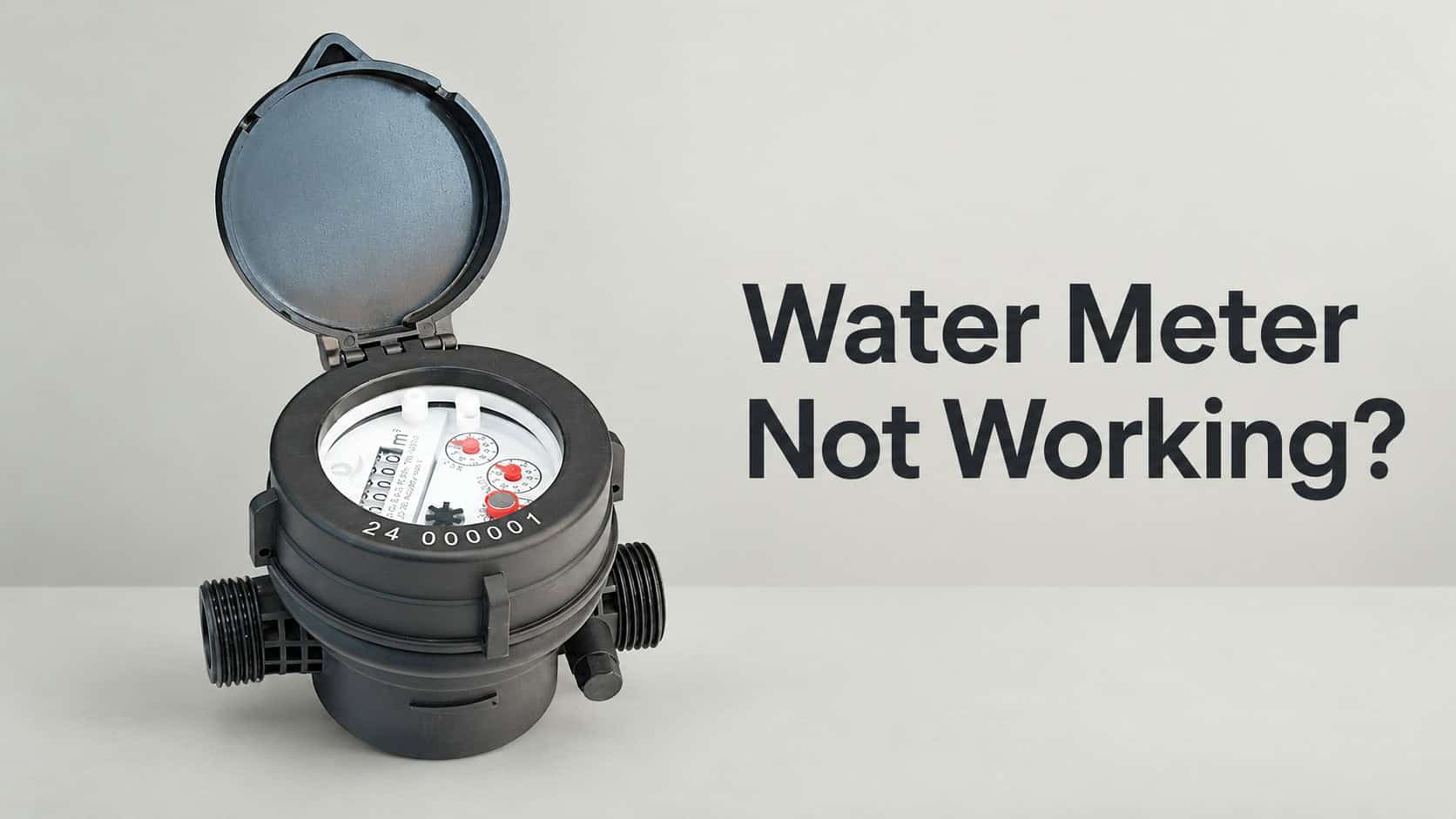
A frozen reading does not always mean a failed meter. First separate a water-supply problem, a meter that stops recording, and a remote-reading outage. The local display and latest transmitted reading usually tell your team where to investigate.
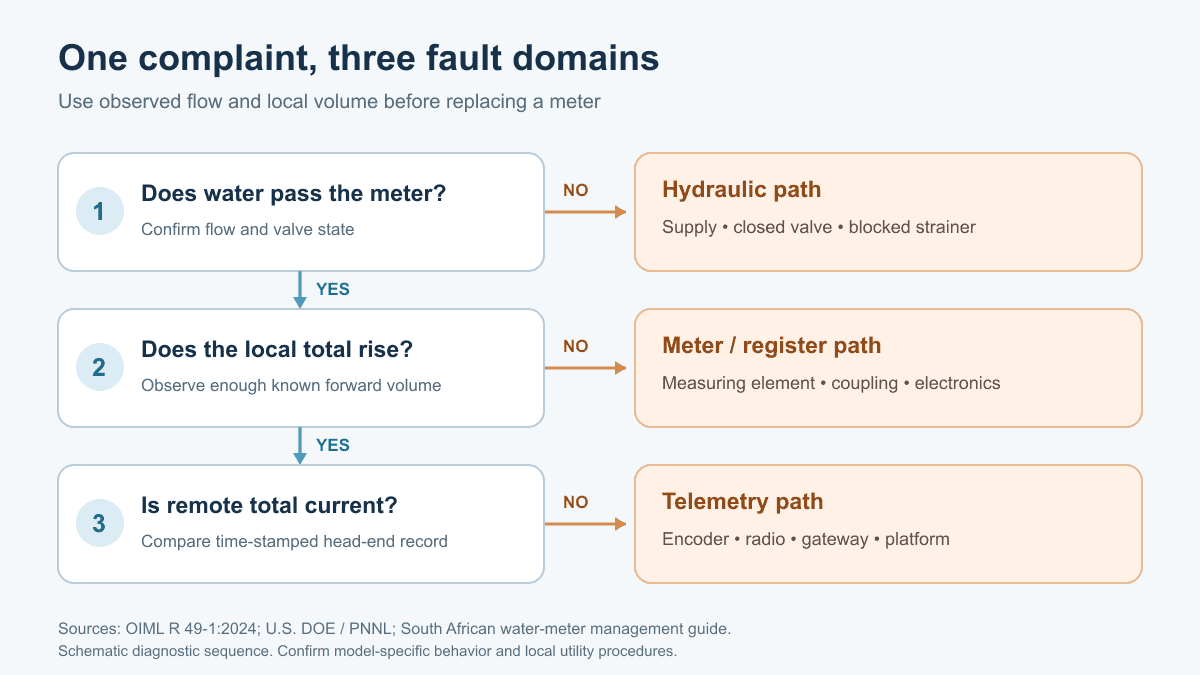
Locate the failed layer first
“No reading” can describe three different systems. Record the serial number, local total, and time before changing a valve, module, or platform setting.
Give a stopped register enough flow to show a change
OIML R 49-1:2024 calls Q1 the meter’s minimum rated flow. Below that point, its stated error limit does not apply. A tiny trickle is therefore a poor way to judge whether a meter has stopped.
- Allow for display resolution. Our DN15 LXC-15 ultrasonic meter lists a minimum rated flow of about 6.3 L/h and a 0.1 L minimum reading. At that flow, only about 0.05 L passes in 30 seconds, so its displayed digit may not move.
- Challenge the cumulative total. Use a steady, known forward flow and pass enough water for the displayed total to change. An instantaneous-flow screen is not the same reading.
- Escalate a static result. If the total still does not move, use the model’s authorized test mode or send the meter for a controlled test.
After network work, inspect the hydraulic path
A water-meter management guide documents sediment after pipe bursts or poor flushing, closed valves, and reversed check valves as causes of apparent meter failure following network work.
| Observed pattern | Likely fault path | Utility response |
| Upstream pressure, but no water downstream | Closed valve, obstruction, or jammed measuring chamber | Isolate the line and inspect the hydraulic path before blaming AMI. |
| Confirmed flow, but mechanical pointer stays still | Blocked element or failed drive | Inspect the strainer and removed meter; clear debris and flush the line before refitting. |
| Pointer moves, but number wheel does not | Register linkage or drum fault | Send the unit for service or controlled testing; preserve its seal and serial record. |
A utility maintenance manual documents broken impeller-to-register links and pointer movement without a changing indicator. Keep the failed unit intact for a billing dispute or batch investigation.
Blank display, battery warning, and zero-flow movement
- Blank screen: Follow the model’s wake procedure first. If it remains blank, review battery and reset events before classifying it as a register failure.
- Low-battery warning: OIML R 49-1:2024 requires the register display on applicable meters to remain usable for at least 180 days. This does not guarantee radio service for the same period.
- Total rising at “zero flow”: Confirm that flow has truly stopped. An open branch, leak, or reverse-flow event can move real water; the standard says totalization must not change when no water flows.
Local volume rises, but AMI remains unchanged
If the on-site total rises during confirmed use but the AMI record stays unchanged, the meter is still registering water. Investigate how that reading moves from the register to the billing system before replacing the whole meter.
- One silent endpoint: Compare its local reading time and serial number with the latest accepted packet, then investigate the encoder, cable, battery, or radio.
- Several silent endpoints: If they share a gateway and stopped reporting together, investigate that shared connection or the platform before ordering individual replacements.
The U.S. Department of Energy’s metering guidance separates the flow-sensing element, register, and AMR/AMI connection. Preserve that separation in the work order: replacing a meter that still totals correctly may leave the communications fault untouched.
Bench test, repair, or fleet replacement?
A confirmed forward-flow challenge with no local volume change justifies removing the unit under the utility’s procedure. Choose the next action from the evidence:
- Test: Compare the returned meter with a calibrated reference at the required flows. OIML R 49-2:2024 describes methods; local approval and utility rules decide which apply. A field glance cannot certify accuracy.
- Repair: Inspect the strainer, mechanical coupling, and register where the model allows service. Keep the as-found condition and test result with the serial record.
- Replace: If mechanical jams recur across a DN15 fleet, our LXC-15 ultrasonic meter is an option with no moving measuring parts. Match its approval, flow range, and communication options to the project.
- Investigate the lot: Group returns by model, lot, installation date, and recent network work. Failures after one main repair suggest a different cause from failures across unrelated sites.
A returned unit that passes its bench test shifts attention back to installation, actual flow conditions, register readout, or the data path. Record both the field symptom and the bench result in the service history; neither alone proves the root cause.
FAQs about Water Meter Not Working
Can a meter pass while its display stays unchanged during a short test?
Yes. A short trickle may pass less water than the smallest displayed increment. Use enough known flow to move the register, then arrange a controlled test if the result remains doubtful.
Does a missing remote reading mean water consumption was lost?
Not necessarily. If the local total advanced and stored readings can be recovered, the metrology and telemetry outcomes differ. Reconcile the register, module, and head-end records before estimating consumption.
Should a utility open a sealed failed meter in the field?
Follow the applicable approval and utility procedure. OIML requires protection against unauthorized adjustment or dismantling; preserving seals and serial-linked evidence is especially important in disputed cases.
Review a Recurring Meter Fault With Us
We manufacture mechanical, smart, and ultrasonic water meters for utility projects. Explore our product range, then contact us with the failed model, flow conditions, fault pattern, lot information, and required test documents.