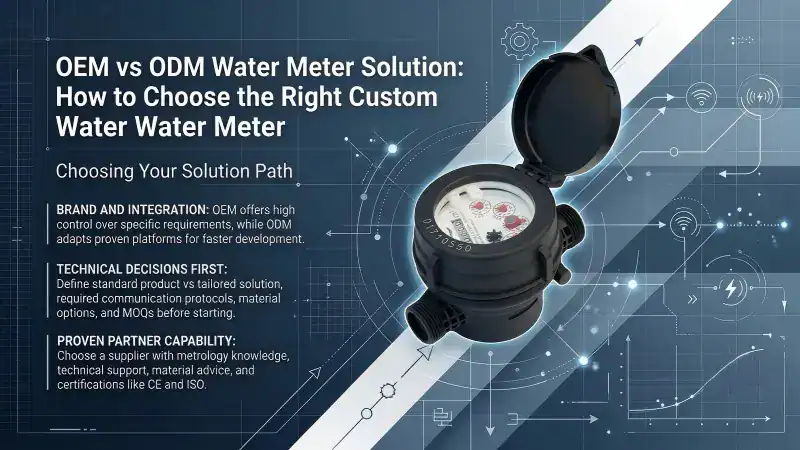
If you are looking for a custom water meter, OEM and ODM are not the same choice. The right path depends on your brand, technical requirement, budget, and how much control you need over the final meter solution.
OEM vs ODM Water Meter: Know the Core Difference
When you compare OEM and ODM, the main question is simple: how much of the meter do you want to control?
With OEM, you usually bring your own specific requirement, drawing, or design concept. The manufacturer produces the water meter to your technical standard. This works well when you need a meter that fits an exact application.
With ODM, the supplier already has a proven meter platform. You adapt that product with your brand, packaging, color, or selected functions. It is often a more cost-effective solution when you want faster development.
OEM Water Meter
OEM is a better fit if you need to customize more deeply. That may include meter body material, register style, communication module, or a specific integration method for your system.
This model suits buyers with strong engineering input, clear metrology goals, and a defined commercial or industrial application.
ODM Water Meter
ODM is usually easier if you want a ready-made base model that you can tailor to your needs. You may still customize packaging, label content, or some feature options.
For many buyers, this is the faster way to offer a reliable water meter without building everything from zero.
When a Custom Water Meter Solution Makes Sense
A custom or bespeak solution may be useful if you need:
- a unique housing or color
- brass or stainless steel options
- NB-IoT, M-Bus, or LoRaWAN integration
- a meter for residential, commercial, or industrial use
- a meter that fits local technical or environmental requirement
DEAZESU supports global OEM/ODM and smart water solutions, with strong R&D, advanced production, and strict quality control.
You can explore our product range here.
Brand, Design, and Integration: What You Should Decide First
Before you choose OEM or ODM, define what you really need the meter to do. This keeps the process practical and avoids over-customization.
Use this quick comparison:
| Factor | OEM | ODM |
| Brand identity | High control | Medium control |
| Design freedom | Higher | Lower |
| Development time | Longer | Shorter |
| Upfront cost | Higher | Lower |
| Technical fit | Best for exact requirement | Best for standard needs |
| Minimum order quantity | Often more important | Usually easier to manage |
A residential meter line may focus on price, stable quality, and easy installation. A commercial or industrial meter project may need more technical integration, communication protocols, and system compatibility.
Think about these points early:
- Do you need a standard product or a tailored solution?
- Will the meter need NB-IoT, pulse output, or M-Bus?
- Do you need packaging and color changes only?
- What minimum order quantity can you accept?
These answers help the supplier provide the right path instead of pushing a one-size-fits-all offer.
Choose a Water Meter Partner That Can Provide More Than Manufacturing
A good supplier should do more than produce a meter. You need a team that can help you manage the full process, from technical review to quality checks and after-sales service.
Look for a partner that can provide:
- metrology knowledge
- technical support during development
- material and component advice
- stable manufacturing quality
- communication module integration
- support for diverse market needs
This is where supplier capability matters. DEAZESU has 20+ years of expertise, a 7,000-square-meter factory, 80+ employees, and certifications including CE, MID, ISO9001, ISO14001, and ISO45001. It also lists mechanical, AMR, ultrasonic, electromagnetic, NB-IoT, and LoRa/LoRaWAN meter categories.
That range can help you choose a meter solution that is easier to fit to your project, whether you need a simple mechanical product or a smarter connected system.
How to Decide Between OEM and ODM
If you are still deciding, keep it simple.
Choose OEM when you need:
- exact technical control
- a specific application fit
- deeper customization
- stronger product differentiation
Choose ODM when you need:
- faster launch
- proven standard technology
- lower development risk
In short, OEM is better when your requirement is highly specific. ODM is better when you want a solid meter solution that you can tailor without starting from scratch.
The Custom Manufacturing Process We Provide to Help You
Moving from an idea to a finished product should be a clear, simple process. At DEAZESU, we offer comprehensive OEM and ODM service to meet your specific requirement. We help guide you through every single stage of development.
Our diverse team approaches custom projects with a structured method:
- Consultation: We analyze your requirement and specific application.
- Prototyping: We create samples that fit your exact specs.
- Testing: We rigorously verify quality and metrology accuracy.
- Production: Full-scale manufacturing begins with strict quality control.
This proven process means we can provide a wide range of smart and mechanical meters that suit diverse global markets. You can explore our full range of baseline models on our products page to see what you can customize, or contact us to discuss your project requirements.
FAQs about OEM vs ODM Water Meters
What is the main difference between OEM and ODM for a water meter?
OEM usually follows your design, requirement, or technical specification. ODM starts from the manufacturer’s existing meter platform, which you can adapt for your brand and market.
Which option is more cost-effective?
ODM is often more cost-effective because the base design and process already exist. OEM may cost more at the start, but it can offer a better fit for a specific application.
Can I customize branding and packaging with ODM?
Yes. Many ODM projects allow brand labeling, packaging changes, and selected visual updates. DEAZESU also states that it supports custom and private-label solutions for branding, packaging, and specification needs.
Does OEM always mean a fully new water meter?
Not always. In many cases, OEM means adapting a proven meter with more technical control, rather than creating a fully new product from zero.
What should I ask a supplier before starting?
Ask about technical support, communication options, material choices, metrology capability, quality process, service response, and minimum order quantity. Those factors will affect both speed and long-term fit.