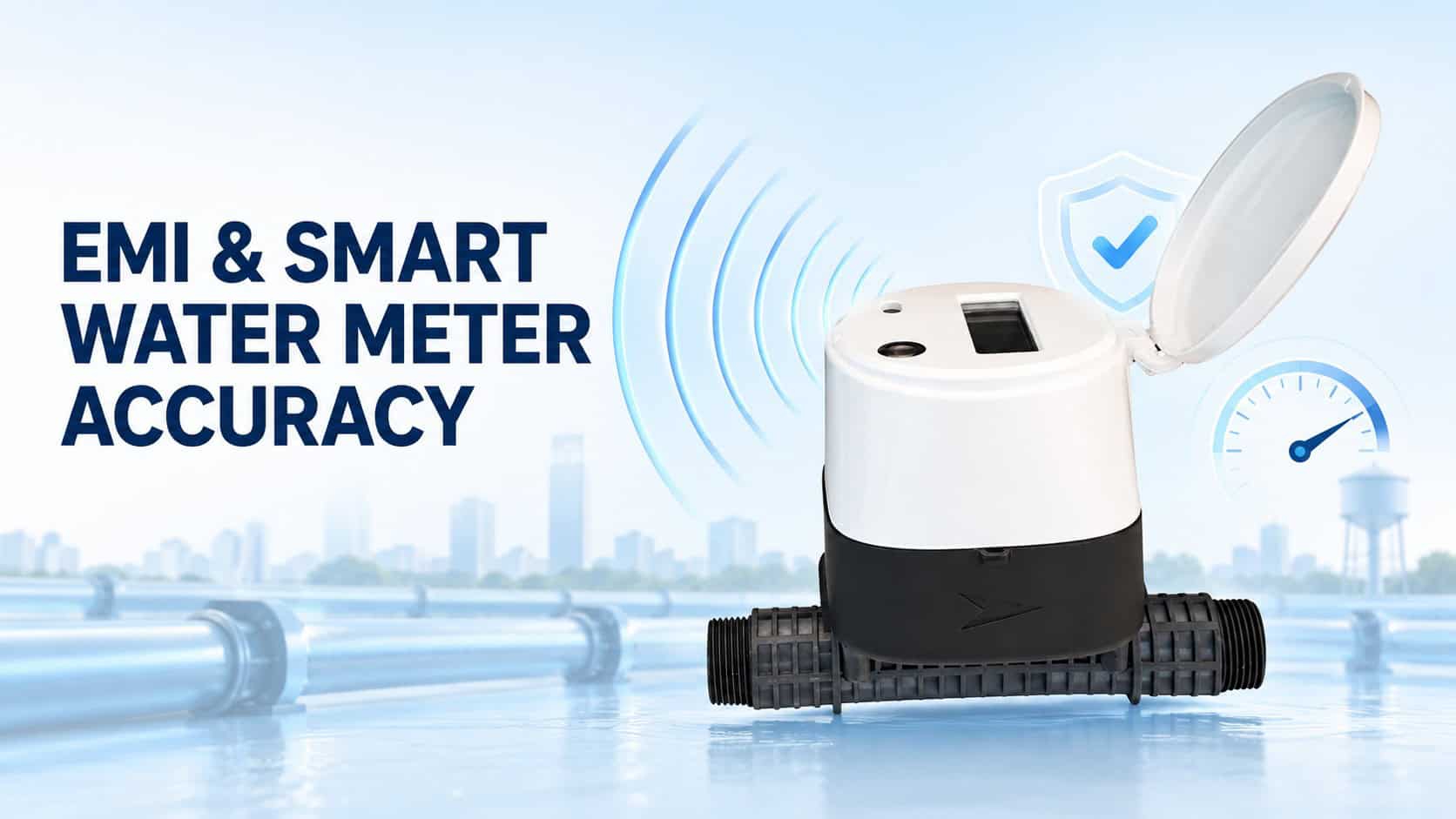
Electromagnetic interference can disturb a smart water meter’s sensor, electronics, power, or communication. A compliant meter should remain within its permitted error or detect the disturbance as a fault—not silently create a believable false total.
Where EMI Enters a Smart Water Meter
Electromagnetic interference, or EMI, is unwanted electrical or magnetic energy coupled into the meter. It may arrive through the air, power wiring, signal cables, pipe potential, or direct electrostatic discharge.
A smart meter contains several paths that can respond differently:
- Flow sensor: converts water movement into an electrical measurement signal.
- Signal processing: filters, amplifies, and converts a small sensor signal.
- Calculator and memory: totalize volume and store readings or events.
- Communication module: transmits data through pulse, M-Bus, LoRaWAN, NB-IoT, or another interface.
- Power circuit: supplies stable energy from a battery or external source.
Interference at one stage does not prove every stage failed. A missed radio packet, for example, can leave the local meter total completely accurate.
Accuracy Error or Data Error?
Start by identifying what changed. The correction depends on whether EMI altered the measured volume, the displayed value, or only the remote data.
| Observed problem | Likely affected layer | First comparison |
| Unstable flow at steady demand | Sensor or analog input | Reference flow versus local indication |
| Total changes at zero flow | Sensor, pulse input, or calculator | Closed-valve observation and event log |
| Local total is correct; AMI total differs | Encoder, cable, or communication | Register, transmitted packets, and head-end data |
| Display resets or freezes | Power or processor | Battery, supply, reset log, and stored total |
| Short data gaps only | Radio link or network | Stored interval data versus received data |
Do not call every communication dropout an accuracy failure. Billing volume, interval data, alarm status, and network availability are separate checks.
Which Meter Types Are Most Exposed?
| Meter type | EMI-sensitive elements | Typical installation focus |
| Mechanical meter without electronics | Magnetic coupling, if fitted | Static magnetic-field resistance |
| Mechanical meter with AMR | Pulse sensor, encoder, cable, and radio | Cable routing, shielding, and pulse validation |
| Ultrasonic smart meter | Timing circuits, processor, power, and radio | EMC class, enclosure, and data integrity |
| Electromagnetic water meter | Electrodes, low-level signal path, converter, and cables | Grounding, equipotential bonding, shielding, and separation |
Electromagnetic meters deserve particular attention because they derive flow from a small voltage induced in conductive water. Stray potential or poor grounding can contaminate that signal.
Ultrasonic meters use a different sensing principle, but their electronic timing and calculator still require immunity. Technology alone does not replace EMC testing.
Common EMI Sources and Warning Signs
Look beyond radio transmitters. Industrial electrical equipment and installation wiring often create stronger coupling paths than a distant antenna.
- Motors, pumps, variable-frequency drives, contactors, and transformers
- High-current or high-voltage cables routed beside meter signal cables
- Radio transmitters, cellular equipment, and handheld radios used close to electronics
- Surges, lightning-related transients, switching events, and electrostatic discharge
- Cathodic-protection current and unequal pipe potentials around electromagnetic meters
- Incorrect grounding, shield termination, bonding, or cable splicing
Useful clues include spikes synchronized with pump starts, noisy zero flow, repeated resets, impossible reverse-flow events, or a local-versus-remote total mismatch.
Those symptoms are not unique to EMI. Air, vibration, low battery, poor pipe filling, incorrect configuration, and hydraulic transients must also be checked.
What E1 and E2 EMC Classes Mean
OIML R 49-1:2024 divides electronic water meters into E1 for residential, commercial, and light-industrial environments, and E2 for industrial environments.
Under OIML R 49-2:2024, radiated-field testing applies 3 V/m for E1 or 10 V/m for E2. The test covers 26 MHz to 3 GHz, or 80 MHz to 3 GHz when the lower range is covered by conducted testing.
Conducted RF testing uses 3 V for E1 or 10 V for E2 from 0.15 MHz to 80 MHz. ESD, bursts, surges, power-frequency fields, and static magnetic fields are tested separately.
The acceptance principle matters more than the label alone. The error change must remain within the specified critical limit, or the meter must detect and act upon a significant fault.
At zero flow, totalization must not change beyond the least significant display digit during the applicable test. Ask for the exact approval and test report, not only “EMC protected” marketing language.
For a verified example, our DN15–DN25 ultrasonic water meter lists climatic class O, EMC class E2, Class 2 accuracy, and IP68 protection.
How to Diagnose Suspected EMI
- Record the local display, remote total, timestamp, flow condition, and active alarms.
- Check whether the event coincides with a pump, VFD, relay, radio, or switching operation.
- Observe the meter at confirmed zero flow, then compare it at a stable known flow.
- Inspect grounding, bonding, cable separation, shield termination, connectors, and supply quality.
- Review configuration and logs before changing filters, thresholds, or calibration factors.
- If uncertainty remains, test the meter against a traceable reference under controlled conditions.
Never diagnose immunity by placing a strong magnet on the meter. You may trigger tamper detection, influence a magnetic coupling, or create a condition unrelated to the approved test method.
How to Reduce EMI Risk
- Select the EMC class for the real installation environment.
- Keep meter and communication cables away from motors, VFD outputs, and power conductors.
- Follow the manufacturer’s grounding, bonding, shielding, and grounding-ring instructions.
- Use specified surge protection, cable glands, connectors, and enclosure practices.
- Capture a commissioning baseline for zero flow, known flow, local total, and remote total.
- Preserve event logs so faults can be matched to electrical and hydraulic operations.
Review our water meter categories by sensing technology and communication method. The correct choice depends on the metrology, environment, installation, and data path together.
FAQs about Electromagnetic Interference and Smart Water Meters
Can a nearby magnet change a smart water meter reading?
It depends on the design. Magnetic couplings, pulse sensors, and electronic components may be tested for static-field immunity. Do not assume resistance without model-specific evidence.
Does wireless communication interfere with measurement?
A compliant design separates radio operation from metrology, but immunity still requires verification. A communication failure may delay data without changing the local accumulated volume.
Is E2 always better than E1?
E2 covers the industrial electromagnetic environment at higher specified RF test levels. Choose the class required by the site and applicable approval rather than treating it as a universal quality score.
Can software filtering fix EMI?
Filtering can suppress some noise, but it cannot replace correct grounding, cable routing, shielding, power integrity, and appropriate hardware immunity. Excessive filtering may also hide legitimate flow changes.