Use the orientation approved for the exact meter—not the position that merely fits the pipe. Horizontal and vertical installations can both measure accurately, but only when the nameplate, flow direction, measuring range, and pipe conditions agree.
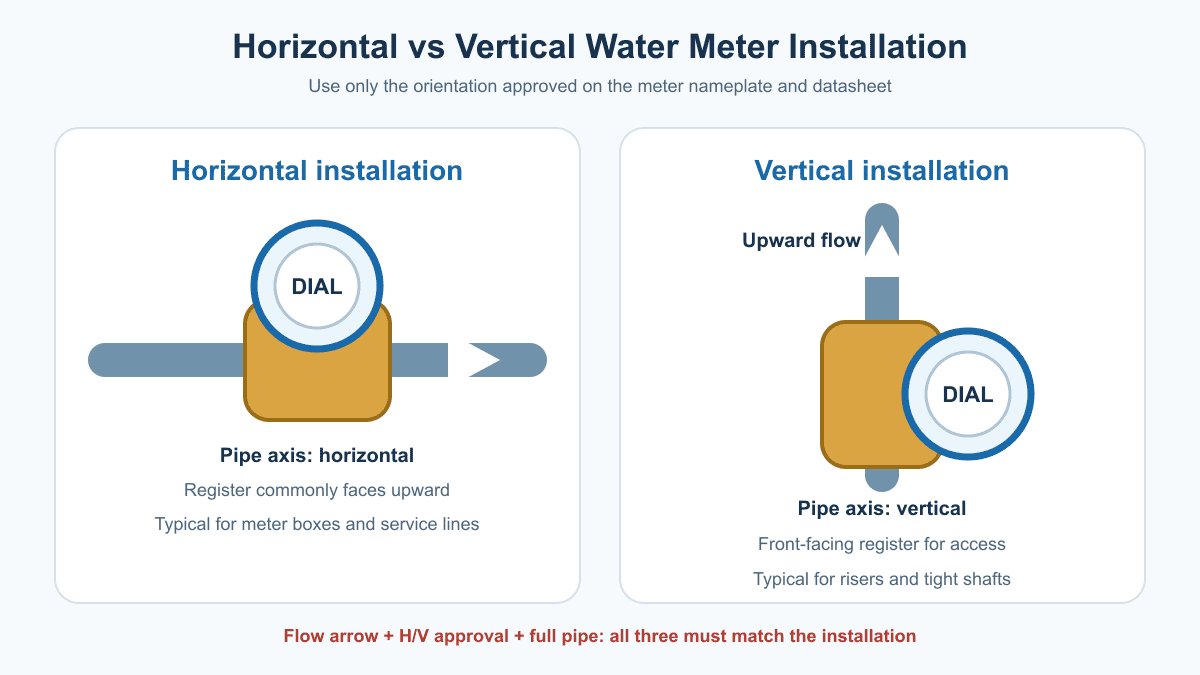
Horizontal vs Vertical Installation at a Glance
| Decision point | Horizontal installation | Vertical installation |
| Pipe layout | Horizontal service line, meter box, or main | Riser, shaft, wall branch, or tight plant room |
| Required approval | H or an approved multi-position rating | V or an approved multi-position rating |
| Register position | Usually faces upward | Usually faces forward for eye-level reading |
| Preferred flow | Follow the body arrow | Upward flow generally helps move air onward |
| Typical mechanical risk | Sideways or face-down mounting can change bearing loads | A horizontal-only meter may suffer extra friction and wear |
| Measuring range | Check the H-specific R value | Check the V-specific R value; it may be lower |
| Straight pipe | Use the exact upstream and downstream lengths stated for the model | |
The practical rule is simple: pipe direction does not decide meter approval. A vertical pipe needs a V-rated or multi-position meter. Rotating an H-only meter does not make it a vertical model.
What Installation Position Changes
Orientation changes how gravity acts on pistons, impellers, bearings, magnetic couplings, and registers. It can also change where air collects and whether the measuring tube remains completely full.
- Low-flow response: extra mechanical friction can raise the flow needed to start or measure reliably.
- R value: one meter may carry different Q3/Q1 ratios for horizontal and vertical positions.
- Wear: an unapproved position can load a bearing or piston unevenly.
- Readability: the counter must remain visible without turning the meter into an unapproved position.
- Air control: a partially filled pipe or trapped bubbles can disturb measurement.
Do not use a generic “3D,” “5D,” or “10D” straight-run rule for every meter. Volumetric, multi-jet, ultrasonic, and electromagnetic designs have different sensitivity classes and installation requirements.
Read H, V, R, and the Flow Arrow
| Marking | Meaning | Your action |
| H | Approved for a horizontal pipe position | Keep the meter in the documented horizontal orientation |
| V | Approved for a vertical pipe position | Confirm whether upward, downward, or both flows are permitted |
| H + V | Both pipe positions are approved | Compare the R value stated for each position |
| R160H / R80V | Example of orientation-specific measuring ranges | Use the value matching the installed position |
| Body arrow | Approved direction of water flow | Align the inlet and outlet correctly |
| No clear position mark | Orientation cannot be confirmed from the body | Check the type approval and manufacturer datasheet |
R is calculated as Q3 ÷ Q1. A larger R describes a wider certified measuring range; it does not prove that one installation direction is universally more accurate.
Verified DEAZESU Product Examples
The following data comes from three current DEAZESU product pages. The models use different technologies and nominal sizes, so the table shows real selection examples—not a controlled laboratory comparison.
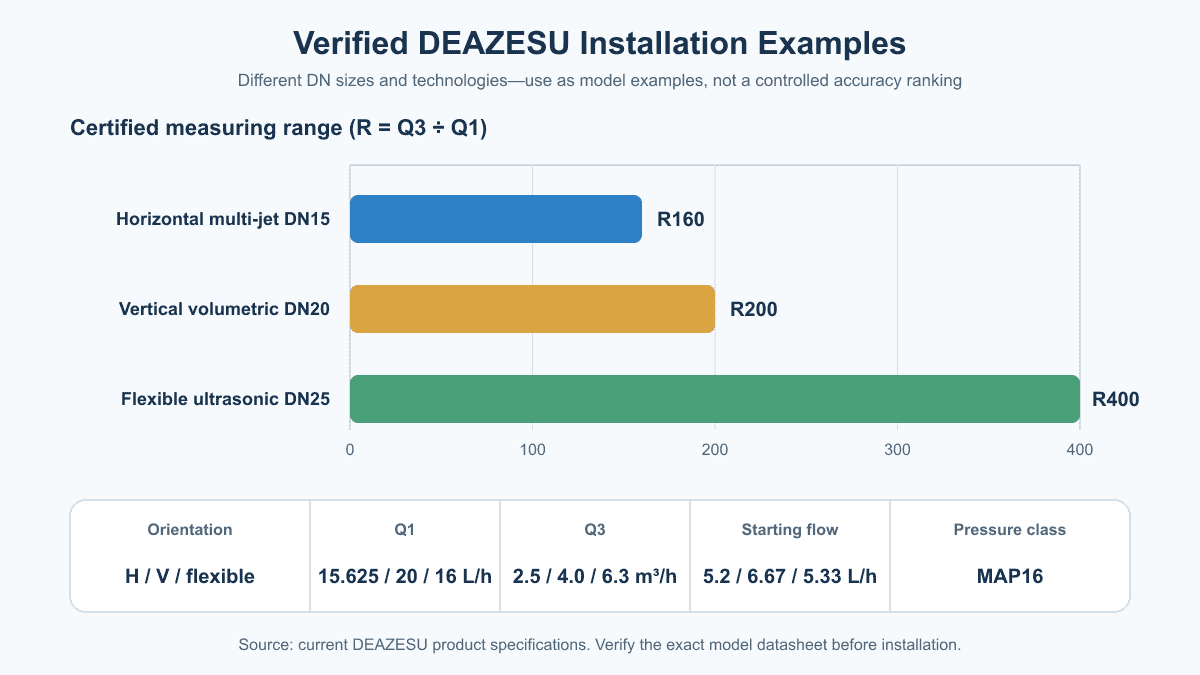
| Specification | Horizontal multi-jet | Vertical volumetric | Flexible ultrasonic |
| Nominal size | DN15 | DN20 | DN25 |
| Installation | Horizontal | Vertical | Any approved location |
| R value | R160 | R200 | R400 |
| Q1 | 15.625 L/h | 20 L/h | 16 L/h |
| Q2 | 25 L/h | 32 L/h | 25.2 L/h |
| Q3 | 2.5 m³/h | 4.0 m³/h | 6.3 m³/h |
| Q4 | 3.125 m³/h | 5.0 m³/h | 7.87 m³/h |
| Starting flow | 5.2 L/h | 6.67 L/h | 5.33 L/h |
| Temperature class | T30/T50/T90 | T30/T50 | T30/T50/T90 |
| Pressure class | MAP16 | MAP16 | MAP16 |
For a conventional horizontal service line, review our DN15 R160 multi-jet water meter. For a building riser, compare the DN20 R200 vertical volumetric meter.
Installation Checklist
- Confirm the exact model, DN size, H/V approval, temperature class, and pressure class.
- Match Q1 and Q3 to the minimum, normal, and peak flow expected on site.
- Flush the pipe before installation; fit a strainer when the datasheet requires one.
- Align the body arrow with the real flow direction.
- Keep the pipe full and avoid high points that collect air.
- Use the specified straight runs and keep valves, pumps, and bends at the required distance.
- Support the pipe so its weight and alignment do not stress the meter body.
- Provide isolation valves and enough clearance for reading, sealing, testing, and replacement.
- Open the supply slowly, vent air, inspect for leaks, and verify the first reading.
Choose by Pipe Layout and Measurement Need
| Site condition | Best starting point | Confirm before ordering |
| Horizontal meter box | H-rated mechanical or solid-state meter | Register position, pit flooding, and reading access |
| Narrow vertical riser | V-rated volumetric or approved solid-state meter | Upward-flow approval, width, valves, and service clearance |
| Frequent low consumption | Correctly sized meter with a low Q1 | R value in the actual installation position |
| Layout may change | Approved multi-position ultrasonic model | Full-pipe condition, power, communications, and local approval |
FAQs about Horizontal vs Vertical Water Meter Installation
Can a horizontal water meter be installed vertically?
Only if the exact model is also approved for V installation. Otherwise, changed bearing or piston loading can reduce low-flow performance and service life.
Is upward flow always required for a vertical meter?
Upward flow is generally preferred because it helps keep the pipe full and carry air onward. The body arrow and approved manual remain decisive.
Why can R values change with orientation?
The certified Q1 may change when gravity acts differently on the measuring mechanism. That changes Q3/Q1 even when the body size and Q3 stay the same.
Does a larger R automatically mean a better meter?
No. First match Q3 to demand, then compare Q1, pressure loss, water quality, orientation, communication, and approval requirements for the actual project.
Choose the Right Meter with DEAZESU
Founded in 2007, DEAZESU operates a 7,000 m² factory with more than 80 employees. We manufacture mechanical, IoT, ultrasonic, and electromagnetic water meters for residential, commercial, industrial, and utility projects.
Send us your pipe orientation, DN size, minimum and peak flow, communication method, and required approval through our contact page. We will help you compare suitable horizontal, vertical, or flexible-installation water meter specifications for your project.