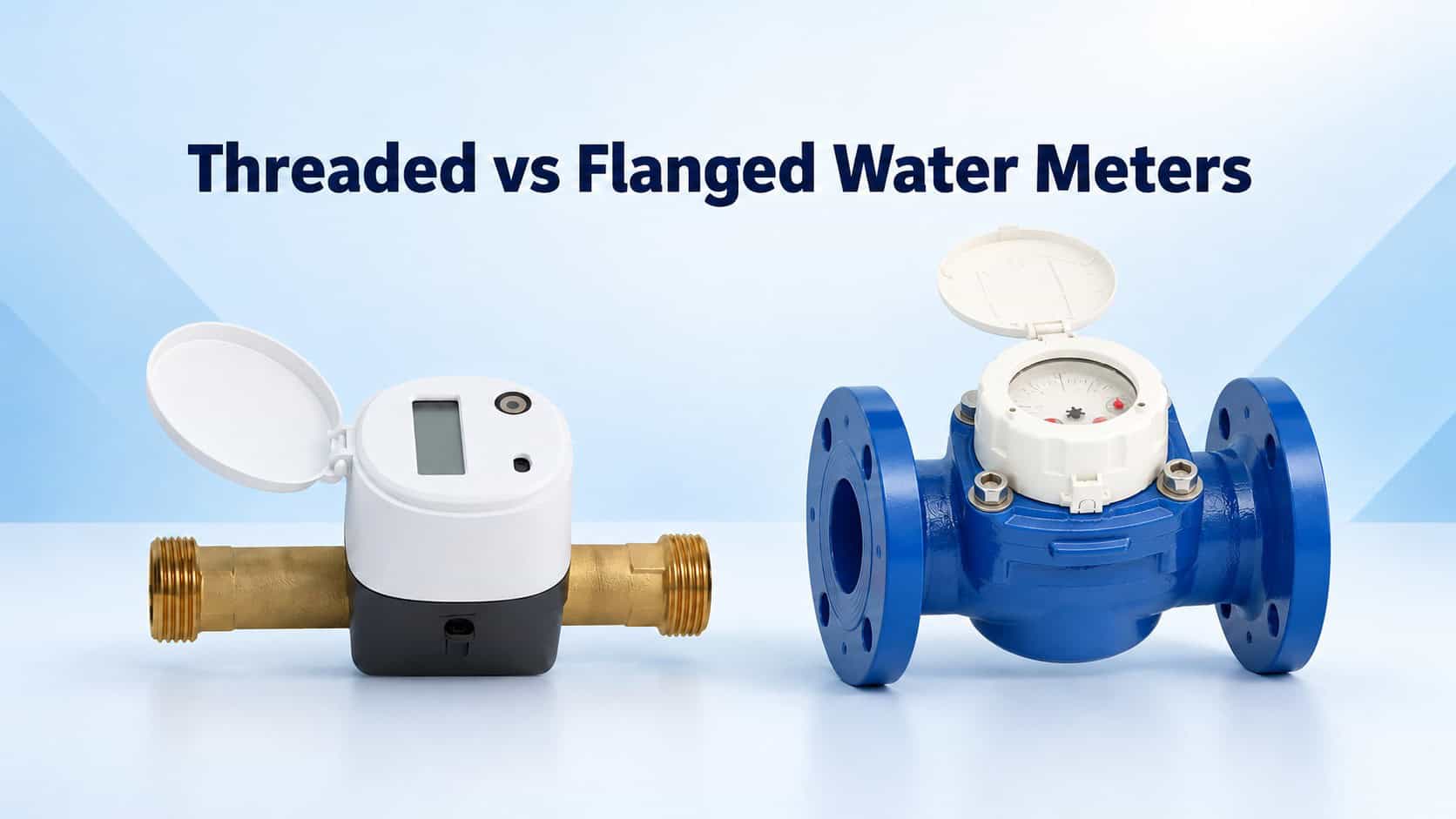
Choose the water meter connection that matches your pipework, meter size, pressure class, service space, and local standard. Threads suit many compact installations; flanges offer a structured, bolted interface for larger or heavier meters.
Threaded vs Flanged Water Meters at a Glance
| Decision point | Threaded water meter | Flanged water meter |
| Typical interface | Meter spud and union coupling, or a specified pipe thread | Two matched flange faces, gasket, bolts, and nuts |
| Common use | Residential, branch, and compact commercial lines | Bulk, commercial, industrial, and municipal lines |
| Space and weight | Compact and relatively light | Needs bolt clearance, alignment space, and pipe support |
| Service work | Union nuts simplify meter removal when access is clear | Bolted joints are repeatable but involve more hardware |
| Main compatibility risk | Wrong thread form, size, coupling, gasket, or lay length | Wrong DN, pressure class, drilling, face type, gasket, or bolt set |
The connection does not determine accuracy. Meter technology, Q1–Q4 flow ratings, pressure loss, orientation, water quality, and installation conditions remain separate selection factors.
How Each Water Meter Connection Seals
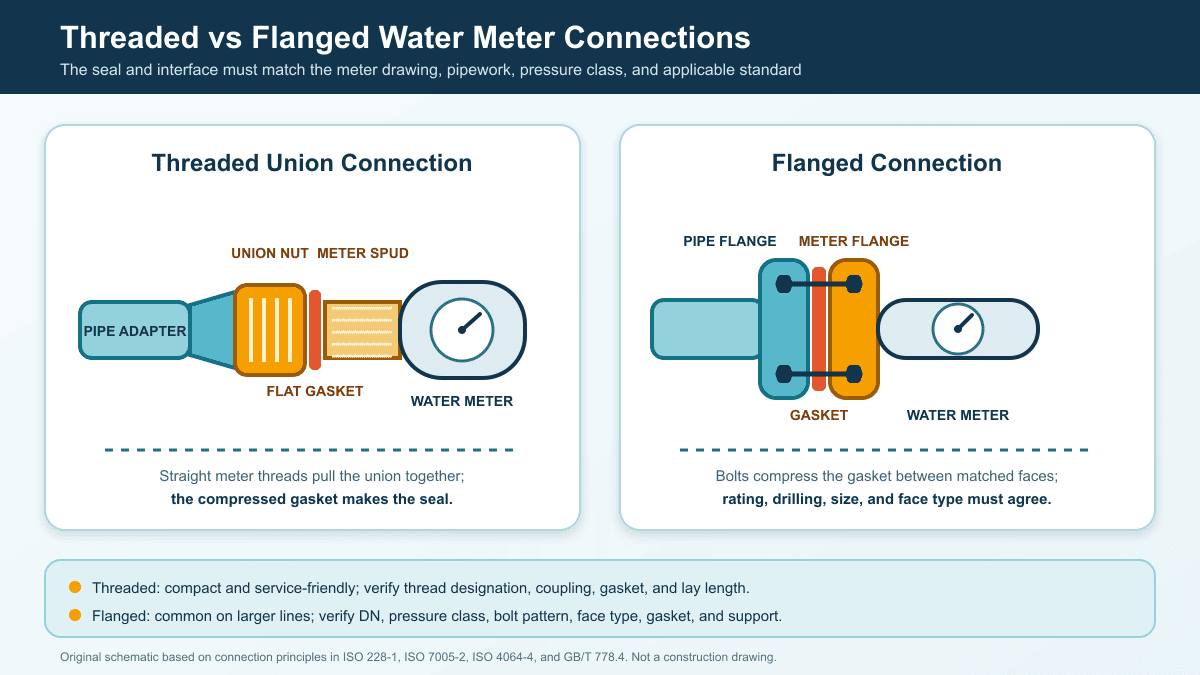
Threaded unions usually seal at a gasket
Many water meter threads are straight fastening threads. The union nut pulls two surfaces together while a flat gasket forms the pressure seal.
That is different from a tapered pipe thread that seals on the thread. Do not assume NPT, BSPT, BSPP, AWWA meter thread, or another system from nominal size alone.
ISO 228-1 covers parallel pipe threads where pressure tightness is created outside the threads with an appropriate seal. Always follow the meter drawing and coupling instructions.
Flanges seal between bolted faces
A flanged water meter sits between compatible pipe flanges. Tightened bolts compress a selected gasket across the sealing faces.
The meter flange and mating flange must agree on nominal diameter, pressure class, dimensions, drilling pattern, face type, gasket, and fastener requirements.
When to Choose a Threaded Water Meter
Threaded connections are a practical starting point when the meter and pipe are compact, the assembly has suitable unions, and maintenance access is limited.
- You are replacing a small meter in an existing setter or union spacing.
- The approved meter drawing matches the installed thread designation and lay length.
- The meter can be removed without rotating or stressing the building pipework.
- Correct coupling nuts, tailpieces, and potable-water gaskets are available.
Never force a nearly matching thread. It can damage the spud, misalign the meter, or create a joint that appears tight but leaks under pressure.
When to Choose a Flanged Water Meter
Flanges are common when the meter is larger, heavier, or integrated into industrial and utility pipework with standard bolted joints.
- The pipeline already uses a compatible flange standard and pressure class.
- You need a stable interface for a bulk or Woltman water meter.
- The design provides space for bolts, tools, lifting, removal, and gasket replacement.
- Pipe supports prevent the meter body from carrying external piping loads.
A flange does not automatically provide a higher pressure rating. The complete assembly is limited by its lowest-rated meter, flange, gasket, fastener, valve, or pipe component.
Two Verified Water Meter Examples
These current DEAZESU specifications illustrate typical connection choices. They are product examples, not a claim that every DN25 must be threaded or every DN50 must be flanged.
| Specification | DN25 single-jet meter | DN50 Woltman meter |
| Connection | Threaded | Flanged |
| Connection detail | G1 1/4B BSP | Flange connection |
| Nominal diameter | DN25 | DN50 |
| Meter length | 160 mm | 280/200 mm options |
| Permanent flow Q3 | 6.3 m³/h | 40 m³/h |
| Pressure class | MAP16 | MAP16 |
The table also shows why DN and connection type cannot replace flow sizing. Confirm the complete datasheet rather than choosing from thread or flange appearance.
Specifications to Confirm Before Ordering
- Flow duty: minimum flow, normal flow, peak flow, Q1, Q3, Q4, and R-ratio.
- Interface: DN, thread designation or flange standard, pressure class, face type, and bolt pattern.
- Dimensions: meter length, coupling spread, flange thickness, register height, and service clearance.
- Installation: approved orientation, flow arrow, straight-pipe requirements, strainer, valves, and supports.
- Environment: water temperature, water quality, pit flooding, corrosion exposure, power, and communications.
- Compliance: utility approval, potable-water requirements, local plumbing rules, and the specified standards edition.
ISO 4064-4:2024 covers non-metrological technical characteristics and pressure-loss requirements. Connection drawings still need the applicable thread or flange standard and project-specific approval.
Avoid These Installation Mistakes
- Using thread tape or sealant on a straight meter union designed to seal with a gasket.
- Confusing nominal meter size with the measured outside diameter of a thread.
- Pulling misaligned flanges together with bolts instead of correcting the pipe alignment.
- Reusing a damaged, hardened, contaminated, or incorrectly sized gasket.
- Letting the meter carry pipe weight or tightening the joint against unsupported pipework.
- Ignoring flow direction, orientation, straight lengths, or the need to fill the line slowly.
After installation, inspect for leaks, release trapped air, open valves gradually, and confirm the register responds correctly at a controlled flow.
FAQs about Threaded vs Flanged Water Meters
Are water meter threads the same as pipe threads?
Not always. Meter unions may use straight threads and a gasket, while pipe connections may use tapered threads. Verify the exact designation before selecting an adapter.
Can you replace a threaded meter with a flanged meter?
Yes, if an approved transition assembly provides compatible size, pressure rating, lay length, alignment, support, and service access. Utility approval may also be required.
Is a flanged water meter more accurate?
No. Connection style does not set metrological performance. Compare the certified flow range, accuracy class, pressure loss, orientation, technology, and actual installation conditions.
Which connection is easier to maintain?
Threaded unions use fewer fasteners, while flanges provide a clear bolted interface. Real serviceability depends on isolation valves, clearance, corrosion, pipe support, and replacement-part availability.
Choose the Right Connection with DEAZESU
We manufacture mechanical, smart, ultrasonic, and electromagnetic water meters for residential, commercial, industrial, and utility projects.
Review our water meter range, then send your DN size, flow range, connection standard, pressure class, lay length, and required approval through our contact page. We will help you compare suitable specifications.