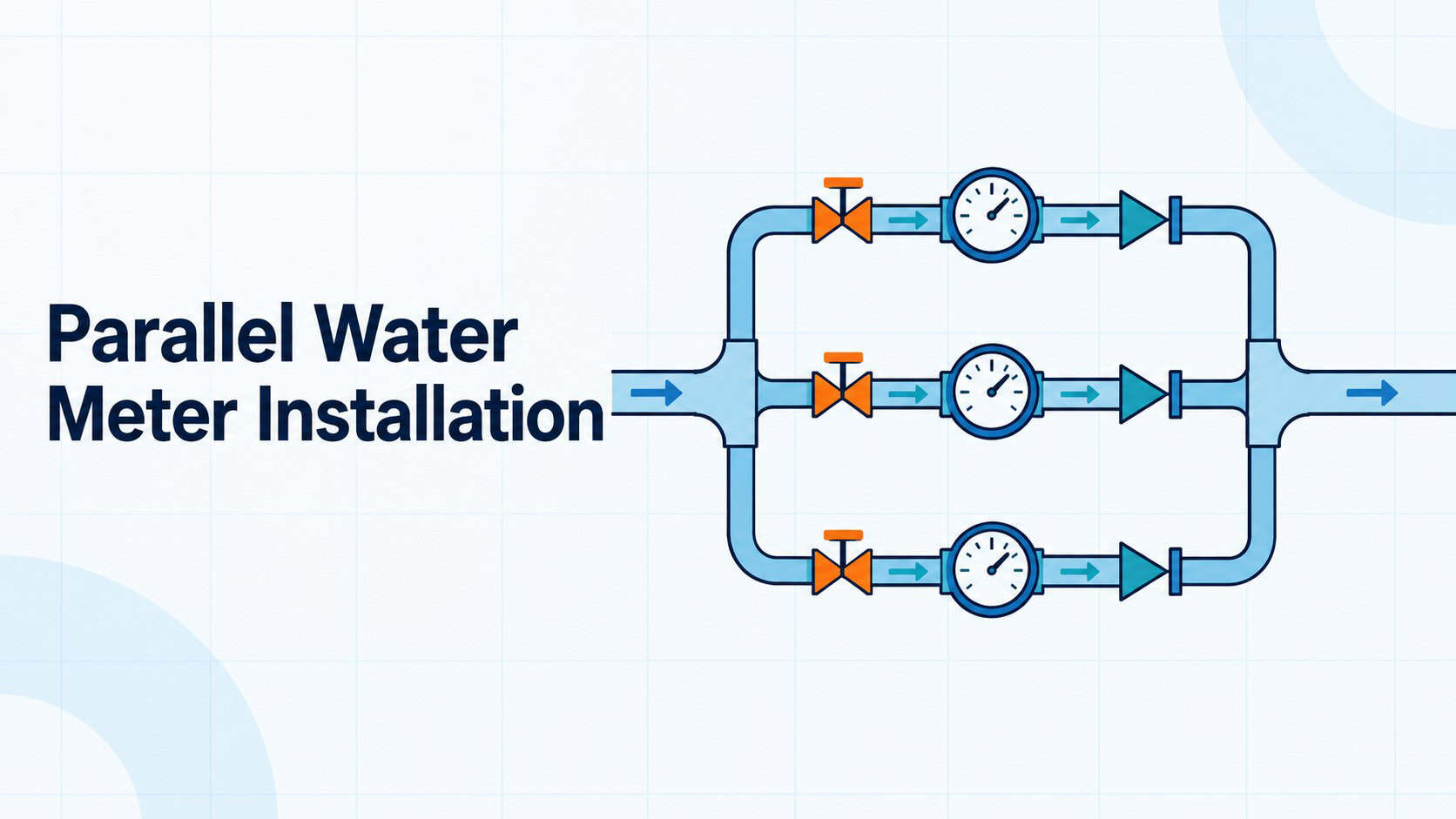
Yes, multiple water meters can be installed in parallel. The arrangement works when meter capacity, branch resistance, valves, backflow protection, and maintenance access are engineered as one system—not treated as separate plumbing runs.
What Is a Parallel Water Meter Installation?
Parallel operation means two or more meters share a common water source and a common delivery pipe. Flow divides between the branches, passes through the meters, then reunites downstream.
This differs from multiple-meter operation used for apartments. Those meters may share an inlet manifold but feed separate units, so their outlets do not rejoin.
| Arrangement | Hydraulic path | Typical purpose |
| Parallel meters | Common inlet and common outlet | More capacity, wider operating range, or service continuity |
| Multiple branch meters | Common inlet or common outlet, but not both | Individual unit measurement or grouped access |
| Meters in series | One meter after another | Comparison or special testing—not increased flow capacity |
When Should Water Meters Be Installed in Parallel?
A parallel water meter installation is useful when one practical meter cannot cover the required flow range or when shutting down the only meter would interrupt an essential supply.
- High peak demand: several smaller meters can share a flow that is impractical for one meter.
- Low-flow sensitivity: a staged arrangement may retain useful low-flow registration while supporting larger peaks.
- Redundancy: one branch can be isolated for inspection while another continues measuring and supplying water.
- Easier handling: smaller meters may be simpler to remove, test, and maintain than one large assembly.
Typical Water Meter Manifold Layout
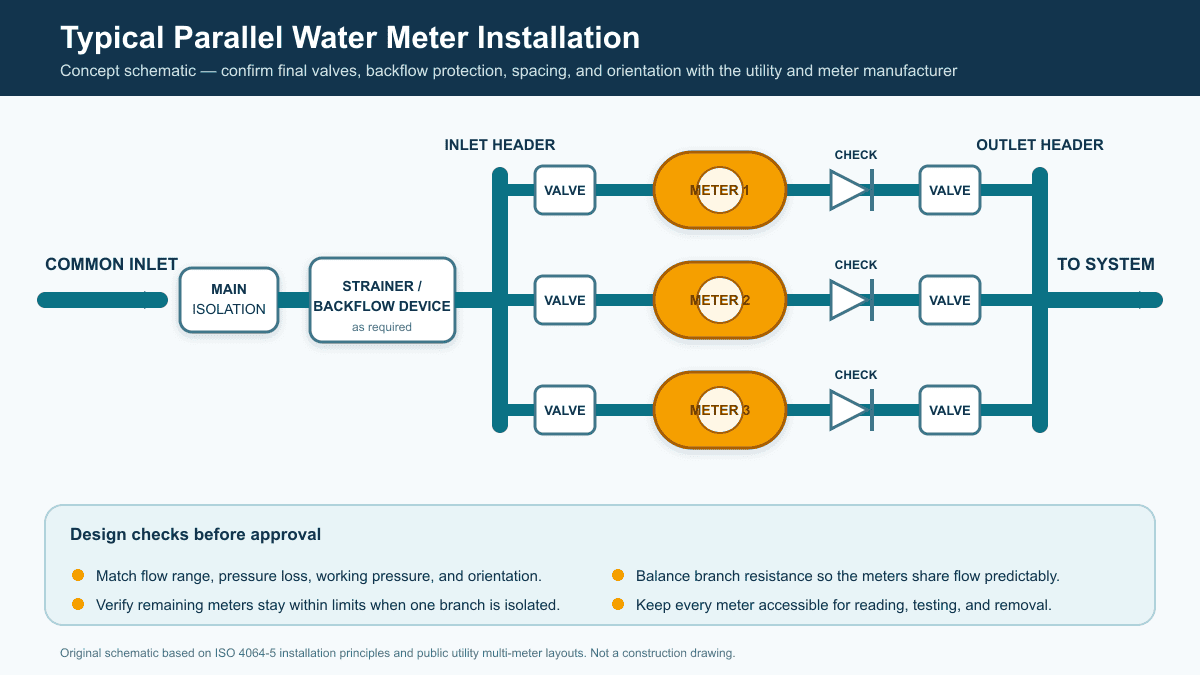
A sound water meter manifold gives each meter an accessible branch with isolation, suitable flow conditioning, and protection against reverse flow. The final arrangement must follow local utility rules and manufacturer instructions.
How to Size Multiple Water Meters
Begin with measured or calculated demand. Record minimum continuous flow, normal operating flow, design peak, duration of peaks, pressure available, water temperature, and water quality.
If identical branches are hydraulically balanced, each meter may carry roughly the total flow divided by the number of active meters. Treat that only as an initial estimate.
| Design question | What to verify |
| How low can demand fall? | Each operating strategy must keep useful flow above the relevant meter’s Q1 where rated accuracy begins. |
| What is the normal flow? | Flow through every active meter should remain within its certified range and not exceed Q3 for continuous operation. |
| What is the short peak? | Confirm both the duration and the Q4 overload limit; do not size routine operation around Q4. |
| What if one meter stops? | The remaining branches must not be pushed beyond their individual operating limits. |
| How much pressure remains? | Add losses through the meter, pipe, tees, valves, strainer, backflow device, and other fittings. |
For duty-and-standby service, the duty meter may need to carry the full design flow. For three meters with one reserved, two operating branches must carry the required demand safely.
Review each candidate’s Q1, Q3, Q4, R-ratio, pressure-loss class, maximum working pressure, temperature class, and approved orientation. Our water meter range provides mechanical, smart, ultrasonic, and electromagnetic options for comparison.
Balance the Branches and Match the Meters
Water follows the lower-resistance path. Different pipe lengths, fittings, valve positions, or meter pressure losses can make one branch carry much more flow than another.
- Use symmetrical headers and similar branch lengths where practical.
- Choose compatible meters by flow range, pressure loss, maximum pressure, and response characteristics.
- Keep operating valves fully open unless a downstream device is specifically designed for flow regulation.
- Follow the meter’s upstream and downstream sensitivity classes and required straight-pipe lengths.
- Support the pipework so removing one meter does not shift or stress another branch.
Valves, Check Valves, and Service Access
Each meter needs a safe means of isolation. For a shared outlet, a downstream check valve prevents water from flowing backward through an idle or lower-pressure branch.
Place components that disturb the velocity profile carefully. Check valves, throttling devices, partly closed valves, and sharp fittings near a meter can affect measurement.
Keep the register readable and the body installed in its approved orientation. See our horizontal versus vertical installation guide before finalizing the manifold.
Provide enough clearance to operate valves, remove meters, connect test equipment, and inspect seals. Permanently label every branch and define which reading contributes to the total.
Installation and Commissioning Checklist
- Obtain utility approval and confirm applicable plumbing, metering, and backflow rules.
- Verify flow arrows, meter orientation, branch labels, supports, and access space.
- Flush the pipework before installing or exposing meters to construction debris.
- Open valves slowly, fill every meter completely, and release trapped air.
- Check joints, pressure, communication outputs, and register operation.
- Measure branch flows under low, normal, and peak demand to confirm balance.
- Isolate one branch and verify the remaining meters stay within rated limits.
- Record initial readings, valve positions, meter serial numbers, and commissioning results.
Parallel Meters vs Other Metering Options
| Option | Best fit | Main caution |
| One bulk meter | Simple systems with a suitable single-meter flow range | Maintenance may interrupt the full supply |
| Parallel manifold | High demand, redundancy, or serviceable capacity | Requires hydraulic balance and coordinated valves |
| Compound meter | Wide flow variation through one metering assembly | Transition behavior and maintenance must suit the application |
| Individual submeters | Separate tenant, unit, or process measurement | Usually not a common-outlet parallel system |
FAQs about Parallel Water Meter Installation
Can two water meters be connected in parallel?
Yes. Both meters connect between common inlet and outlet headers. The branches must be sized, balanced, isolated, and protected so neither meter is overloaded or exposed to reverse flow.
How do you calculate total water use?
Add the registered volumes from all active parallel meters for the same billing period. Smart outputs can automate aggregation, but pulse scaling, timestamps, rollover, and meter identity must be configured correctly.
Can parallel water meters have different sizes?
They can, but flow will not split equally. Use different sizes only with an engineered staging strategy and verified pressure-loss curves, operating ranges, controls, and transition points.
Do parallel water meters need check valves?
A shared outlet can create reverse flow through an inactive branch. A downstream check valve is commonly used, subject to local rules, backflow requirements, and the meter’s approved installation conditions.
Is a parallel manifold better than a compound water meter?
Neither is universally better. Choose by minimum and peak flow, pressure loss, redundancy, installation space, approval, lifecycle cost, and how easily the system can be tested and maintained.
Plan Your Water Meter Installation with DEAZESU
Established in 2007, we manufacture mechanical, IoT, ultrasonic, and electromagnetic water meters for residential, commercial, industrial, and utility projects.
Send your pipe size, minimum flow, normal flow, peak demand, pressure, orientation, communication method, and required approval through our contact page. We can help you compare suitable meter specifications for your manifold design.